

In a traditional classroom, learning often ends when the lecture does. But during Spring 2026 at Rutgers University–New Brunswick, students engaging with the Department of Agricultural, Food, and Resource Economics (DAFRE) stepped into something different—an experience where coursework extended directly into conversations with industry leaders, entrepreneurs and decision-makers. Guided by Sonal Pandey, a lecturer in […]
Faculty
New Model Shows How Plants Optimize Photosynthesis From Top to Bottom of Canopy

Plants are remarkably good at adjusting how they capture sunlight and produce food through photosynthesis. A new computer model helps scientists better understand these adjustments by looking at what happens at different heights within a plant canopy, from the sun-drenched leaves at the top to the shaded leaves near the ground. Chi Chen, assistant professor […]
New ‘RU Engaged’ Program Connects First-Year Students to New Brunswick Through Service
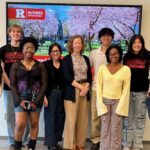
On April 3, Laura Lawson, Executive Dean of the School of Environmental and Biological Sciences (SEBS), spoke with the students gathered in the classroom at the Institute for Food, Nurtition and Health for their final class of the RU Engaged: A Community Engaged Byrne Seminars with Alternative Spring Break. The students in this interactive seminar […]
Rutgers Hosts 35th Annual Turfgrass Symposium

The Rutgers Center for Turfgrass Science hosted its 35th Annual Turfgrass Symposium on March 19, bringing together faculty, students, researchers and industry leaders for a day of collaboration, innovation and knowledge exchange. Held at Rutgers University–New Brunswick, the symposium highlighted the breadth of turfgrass research underway across the university while reinforcing Rutgers’ leadership in advancing […]
Animal Sciences Faculty Wendie Cohick Among Eight Rutgers Researchers Named 2026 AAAS Fellows

Wendie Cohick, Vice Provost and Vice Chancellor for Research, Rutgers-New Brunswick and faculty in the Department of Animal Sciences, is one of eight Rutgers faculty named to the 2026 class of American Association for the Advancement of Science (AAAS) fellows. Cohick and her Rutgers colleagues were among the 500 scientists, engineers and innovators spanning 24 scientific […]
Childhood Obesity Makes It Harder to Climb the Economic Ladder, Study Finds

Childhood obesity may be quietly undermining one of the central promises of American life. A study by a Rutgers researcher has found that children who are obese are far less likely to climb the economic ladder as adults, raising concerns that a rising health problem also could deny many young Americans the chance to achieve […]
Professor Siobain Duffy and International Team Receive Prestigious UK–US Breakthrough Award for Global Food Security Innovation

At a reception hosted at the British Embassy in Washington, D.C. on March 4, Professor Siobain Duffy and her international research team were recognized with the Pioneering UK–US Breakthroughs (PUB) Award, a distinction honoring seven collaborative teams whose work is addressing some of the world’s most urgent challenges. Presented by His Majesty’s Ambassador to the […]
$1.5 Million Gordon and Betty Moore Foundation Grant Supports Rutgers Postdoctoral Researchers

The School of Environmental and Biological Sciences (SEBS) is among three schools at Rutgers University-New Brunswick to benefit from a $1.5 million grant from the Gordon and Betty Moore Foundation to support 37 postdoctoral researchers. The funding strengthens research in SEBS, the School of Arts and Sciences and the School of Engineering, advancing discovery in […]
Coral Killer: Scientists Uncover New Clues About a Disease Devastating Caribbean Reefs

A mysterious disease has been quietly destroying coral reefs across the Caribbean for over a decade. Stony coral tissue loss disease, or SCTLD, causes coral tissue to simply fall away, killing entire colonies — and no one has been able to pinpoint exactly what causes it. Now, new research is offering some of the clearest […]
Scientists Develop New Gut Health Measure That Tracks Disease

Scientists have identified a new way to distinguish healthy guts from diseased ones and track how some illnesses progress by measuring how gut bacteria interact with one another. According to a study published in Science, a Rutgers-led team of scientists found that healthy and diseased digestive systems behave like two distinct ecological states, driven not by individual microbes but […]