
![[Subscribe via RSS]](https://sebsnjaesnews.rutgers.edu/wp-content/uploads/2013/06/rss-subscribe-button.png)
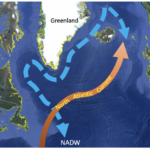
If circulation of deep waters in the Atlantic stops or slows due to climate change, it could cause cooling in northern North America and Europe – a scenario that has occurred during past cold glacial periods. Now, a Rutgers coauthored study suggests that short-term disruptions of deep ocean circulation occurred during warm interglacial periods in the last […]
Marine and Coastal Sciences
Climate Change Could Threaten Sea Snails in Mid-Atlantic Waters
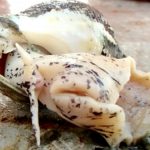
Common whelk live in one of the fastest-warming marine areas, Rutgers-led study says Climate change could threaten the survival and development of common whelk – a type of sea snail – in the mid-Atlantic region, according to a study led by scientists at Rutgers University–New Brunswick. The common, or waved, whelk (Buccinum undatum) is an […]
Scientists Have Discovered the Origins of the Building Blocks of Life
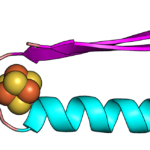
Rutgers researchers retraced the evolution of enzymes over billions of years Rutgers researchers have discovered the origins of the protein structures responsible for metabolism: simple molecules that powered early life on Earth and serve as chemical signals that NASA could use to search for life on other planets. Their study, which predicts what the earliest […]
Exciting Times in Research at SEBS: Antarctic Edge
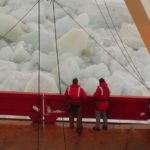
An exciting inter-disciplinary documentary, funded in part by the National Science Foundation, following a world-class team of scientists, including Oscar Schofield chairman of SEBS Department of Marine and Coastal Sciences, as they race across the world’s fastest winter-warming place to study a changing ocean. Imagine yourself here doing hands-on research at SEBS!
Exciting Times in Research at SEBS: Beneath the Marsh
Jennifer Walker, post doctoral student, narrates this film of professor Ben Horton, Department of Marine and Coastal Sciences, and his post-docs doing sea level rise research and exploring the mysteries ‘Beneath the Marsh.’ Imagine yourself here doing hands-on research at SEBS!
Postdoc Laura Haynes Searching for Climate Change Clues Under the Ocean Floor
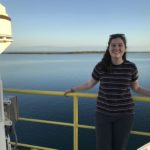
Laura Haynes cruises the world searching for core samples By Craig Winston It’s hard to pinpoint where you might find Laura Haynes, an EOAS post-doctoral fellow, for an interview. During a telephone chat she sounded far away. She explained why in a subsequent email. “I was actually in Fiji, eating breakfast before we headed out to board […]
New EOAS Faculty Member Rebecca Jackson Researches Ocean and Glacier Interactions
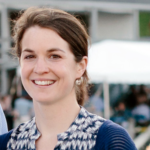
By Mary Ellen Dowd Rutgers Institute of Earth, Ocean, and Atmospheric Sciences (EOAS) faculty member Rebecca Jackson is a physical oceanographer with specialized interests in ocean-glacier interactions, coastal dynamics, and polar processes. Her research focuses on the underwater melting of glaciers, specifically in Greenland and Alaska, and ocean dynamics in the polar regions where various […]
Scientists Find Far Higher than Expected Rate of Underwater Glacial Melting
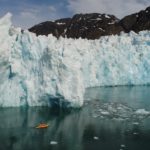
Robotic kayaks were used to track meltwater Tidewater glaciers, the massive rivers of ice that end in the ocean, may be melting underwater much faster than previously thought, according to a Rutgers co-authored study that used robotic kayaks. The findings, which challenge current frameworks for analyzing ocean-glacier interactions, have implications for the rest of the […]
Rutgers Leads $1.5 Million Project for Ocean Acidification Monitoring on the U.S. Northeast Shelf
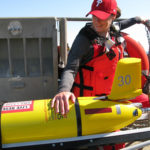
Grace Saba, assistant professor, is the lead principal investigator, and John Wilkin, professor, in the Department of Marine and Coastal Sciences, is co-principal investigator, of a $1,499,895 million project observing ocean acidification on the U.S. Northeast Shelf, from the Mid-Atlantic to the Gulf of Maine. The project, “Optimizing O cean Acidification Observations for Model Parameterization […]
Are We Alone in the Universe? Rutgers Professor Explores Possibility of Life on Mars and Beyond
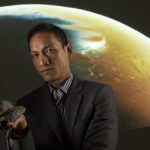
Rutgers’ first astrobiology course explores possibility of alien microbes on other planets and moons People have spent centuries wondering whether life exists beyond Earth, but only recently have scientists developed the tools to find out. One of them is Nathan Yee, a Rutgers University–New Brunswick professor of geomicrobiology and geochemistry and a co-investigator at Rutgers […]