
![[Subscribe via RSS]](https://sebsnjaesnews.rutgers.edu/wp-content/uploads/2013/06/rss-subscribe-button.png)
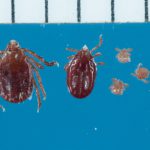
Editor’s Note: Located at Rutgers Center for Vector Biology, the Monmouth County Tick-borne Disease Lab–a collaboration between Monmouth County and the CVB–performed the DNA analysis of the exotic tick. A detailed review on the tick is available on the CVB website. New Jersey Secretary of Agriculture Douglas H. Fisher announced the United States Department of […]
Entomology
Faculty for a Sustainable Future: Alvaro Toledo

Alvaro Toledo is the new assistant professor in the Department of Entomology. His primary focus here at Rutgers will be to establish a research program on Lyme disease, ticks and the vector-borne pathogens at the Center for Vector Biology. He will be investigating the role of cholesterol in the development of Lyme disease. Toledo received […]
Changlu Wang’s Urban Entomology Program Earns HUD Secretary’s 2017 Healthy Homes Award
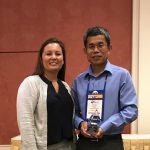
The U.S. Department of Housing and Urban Development (HUD) and the National Environmental Health Association (NEHA) announced that Rutgers Urban Entomology program is one of four model programs around the nation that are recipients of the HUD Secretary’s Award for Healthy Homes, an award recognizing excellence in making indoor environments healthier through healthy homes. For […]
Ticks and Gardening: What’s the Risk?
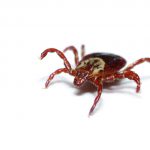
By James L. Occi, graduate student, and Dina M. Fonseca, professor, Department of Entomology Reprinted from Gardener News, August 2016 How likely is it that you will get Lyme disease while gardening? Assuming you are a New Jersey gardener, a state in the U.S. epicenter of Lyme disease, it turns out it depends on how […]
In Memoriam: Stuart R. Race (GSNB ’55 and ’57), Extension Specialist in Entomology
Stuart R. Race passed away May 31, 2017, at the age of 90. Race was an extension specialist in entomology at the New Jersey Agricultural Experiment Station and Cook College, Rutgers University, New Brunswick from 1965 until retiring in 1993. He published many research studies and was well known among the New Jersey farm community […]
Dina Fonseca and her Team Study the Worldwide Movement of Über-Mosquitoes and their Increasing Insecticide Resistance
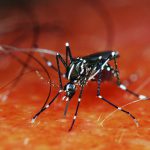
Describing and predicting the unabated movement of mosquitoes across the world has been a research theme throughout the career of Dina Fonseca, professor in the Department of Entomology and director of the Center for Vector Biology. Viruses transmitted by mosquitoes (arboviruses) represent a major threat to public health worldwide, the latest being the Zika virus. […]
Rutgers Awarded $743,000 Federal Grant for Collaborative Science Project

Three Rutgers units are set to begin work this winter on a collaborative science project that will examine the intersection between sea level rise, salt marsh structure, habitat modification and restoration, as well as nuisance mosquito populations that can pose serious health risks to humans, livestock and pets. The project, “Investigating the Interconnectedness of Climate […]
Professor Mark Gregory Robson Wins Statewide Public Health Award

Mark Gregory Robson, distinguished service professor and professor, Department of Plant Biology and Pathology, has been unanimously selected to receive the 2016 Frank J. Osborne Memorial Award by the New Jersey Association of County and City Health Officials (NJACCHO) at the Atlantic City Convention Center on November 16. This award is the highest honor bestowed […]
Alumna Jessica Ware (GSNB’08) Answers on NPR: Why Do We Only See Dragonflies in the Summer?
Jessica Ware (GSNB’08-Entomology), associate professor in the Department of Biological Sciences at the Rutgers-Newark College of Arts and Sciences, tells NPR’s “What’s Bugging You?” the intriguing facts about the life cycle of the dragonfly and its dramatic mating process. Listen at NPR.
New York City’s Chief Zika Hunter, Dr. Jennifer Rakeman (CC’94)

When the Zika virus emerged in the U.S. this year, Dr. Rakeman faced different demands than she did with the Ebola crisis in 2014. She had to quickly train staff to probe for signs of a little-understood virus that lurks for only a short time in urine samples and even more briefly in blood. Public […]