
![[Subscribe via RSS]](https://sebsnjaesnews.rutgers.edu/wp-content/uploads/2013/06/rss-subscribe-button.png)

As any diver knows, oceans can be cloudy places. Even on sunny days, snow-like particles drift through the water column, obscuring the aquatic world below. Scientists have long known that this “marine snow” carries inorganic calcium carbonate – the building block of shells – but couldn’t explain how the mineral dissolves in the upper part […]
Marine and Coastal Sciences
Department of Marine and Coastal Sciences Faculty Recognized at the ARIS 2026 Summit

Department of Marine and Coastal Sciences (DMCS) Department Chair Oscar Schofield and Professor Kay Bidle were honored for their work elevating research impact at the 2026 Center for Advancing Research Impact in Society (ARIS)’s Summit, “Impact by Design”, which took place March 30 – April 1. Schofield was awarded the Enduring Achievement Award, which honors those with a long and storied […]
Can Penguins Help Teach Kids About Climate Change? New Research Says Yes

Penguins waddling across Antarctic ice might seem far removed from a classroom in New Jersey, but a new study shows that these charismatic birds can be a powerful hook for teaching young people about climate change — and inspiring them to see themselves as future scientists. The study was led by researchers at Rutgers University, […]
Will Melting Glaciers Slow Climate Change?
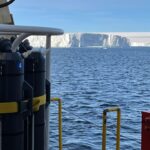
For scientists who study the Southern Ocean, a long-standing silver lining in the gloomy forecast of climate change has been the theory of iron fertilization. As temperatures rise and glaciers in Antarctica melt, ice-trapped iron would feed blooms of microscopic algae, pulling heat-trapping carbon dioxide from the atmosphere as they grow. There’s just one problem: The theory doesn’t […]
Wind Turbines and Fish: Can the East Coast Have Both?

Miles off the coast of New Jersey and New England, two major forces are converging: the rapid expansion of offshore wind energy and some of the most valuable fisheries in the United States. A new editorial published in Fisheries Oceanography takes stock of what we know — and what we urgently need to find out […]
Scientists Prove Shellfish Can Be Farmed Far From Shore
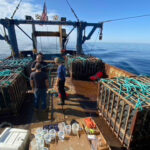
Rutgers researchers have made a discovery that could change the future of seafood farming in New Jersey. A study led by marine scientist Daphne Munroe has shown that Atlantic surfclams can be successfully farmed in the open ocean. Her research, published in the North American Journal of Aquaculture, proves that offshore aquaculture is not only possible but promising. This […]
DMCS Faculty Corday Selden Honored with Oceanography Society Early Career Award

Corday Selden, assistant professor in the Department of Marine and Coastal Sciences at Rutgers University–New Brunswick, has been selected to receive The Oceanography Society (TOS) Early Career Award. The honor recognizes outstanding early-career research contributions, leadership in ocean sciences, and exceptional promise for future impact in oceanography. Selden will be recognized at the TOS Honors […]
The Next Generation of Ocean Explorers Chart 2026 Expedition

Long before leaving port, Rutgers oceanographers Joe Gradone and Corday Selden are focused on packing crates of sensors, autonomous underwater gliders and instruments—some “as delicate as a potato chip”—for a mission to probe one of the ocean’s most elusive processes. In August 2026, the pair will lead a 28-day expedition aboard the state-of-the-art R/V Falkor […]
New Documentary Captures the Perspectives of Scientists as Rising Sea Levels Threaten the Rutgers University Marine Field Station
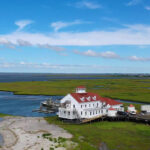
Marine scientists in Tuckerton, N.J., are witnessing firsthand how rising ocean waters will one day permanently shut down their research station. The researchers share their thoughts on eventually losing this critical hub of marine and coastal research in Marine Field Station: The Retreat, a 10-minute documentary made by a Rutgers University-New Brunswick professor and his production crew […]
Marine Geoscientists Link Warming with Ancient Ocean ‘Salty Blob’
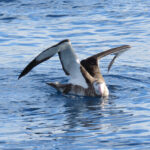
In a groundbreaking study of ancient ocean geochemistry, a Rutgers researcher and a former Rutgers graduate student have found evidence that the end of the latest ice age some 18,000 years ago, a period of rapid planetary warming, coincided with the emergence of salty water that had been trapped in the deep ocean. The findings, published […]