

A study published by the W. M. Keck Institute for Space Studies in collaboration with Rutgers University, NASA’s Jet Propulsion Laboratory and the California Institute of Technology, presents a roadmap for harnessing global-scale trace gas and atmospheric wind observations to improve the monitoring, attribution and mitigation of the greenhouse gases that drive climate change. The […]
Research
Scientists Document Fight Against Basil Disease in New Video Series
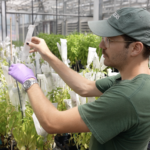
In laboratories and greenhouses at Rutgers University-New Brunswick – alongside collaborators at the University of Massachusetts Amherst, University of Florida and Bar-Ilan University – scientists are advancing plant breeding innovations to protect one of the world’s most widely used herbs: basil. Now, supported by a $3.2 million grant from the U.S. Department of Agriculture’s National […]
China’s Green City Gap: Why Some Urban Areas Are Racing Ahead While Others Fall Behind

Cities across China are transforming to become more environmentally sustainable, but this “green transition” is happening very unevenly—and new research reveals that the biggest gaps aren’t between provinces, but between cities within the same province. A study published in the journal Habitat International examined nearly 300 Chinese cities from 2004 to 2021 to understand why […]
One Size Fits All? Testing Coating Thickness for Solar Panels

As the world races to reduce fossil fuel use and combat climate change, solar energy has become the fastest-growing renewable energy source globally. But not all solar panels are set up the same way. Some are fixed in place, tilted toward the sun. Others track the sun’s movement throughout the day. And a newer type, […]
New Forecasting Model Could Help Unlock the Power of Large Offshore Wind Turbines

As wind turbines grow taller to capture stronger and steadier winds over the ocean, predicting how much electricity they’ll generate becomes more complex. A new study published in the journal Technometrics, one of the leading peer-reviewed journals in statistics and data science, introduces a powerful forecasting method designed specifically for these next-generation, ultra-scale turbines. The […]
New Workshop Series Helps SEBS & NJAES Faculty Expand their Research Vision

Faculty from SEBS and NJAES gathered on Rutgers’ Cook Campus in January to kick off a dialogue that the SEBS Office of Research hopes will lead to an increase in the high-quality, cross-disciplinary research at Rutgers that often significantly impacts the state and our society, at large. The in-person event was the kickoff of the […]
Scientists Prove Shellfish Can Be Farmed Far From Shore
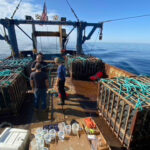
Rutgers researchers have made a discovery that could change the future of seafood farming in New Jersey. A study led by marine scientist Daphne Munroe has shown that Atlantic surfclams can be successfully farmed in the open ocean. Her research, published in the North American Journal of Aquaculture, proves that offshore aquaculture is not only possible but promising. This […]
Scientists Develop New Catalyst That Turns Polluted Water Into Valuable Ammonia
Ammonia is essential for making fertilizers that help feed the world, but producing it typically requires massive amounts of energy and releases significant greenhouse gases. Now, researchers have found a promising new way to create ammonia while simultaneously cleaning polluted water. Tewodros (Teddy) Asefa, affiliate of the Rutgers Climate and Energy Institute, and professor in the […]
The Next Generation of Ocean Explorers Chart 2026 Expedition

Long before leaving port, Rutgers oceanographers Joe Gradone and Corday Selden are focused on packing crates of sensors, autonomous underwater gliders and instruments—some “as delicate as a potato chip”—for a mission to probe one of the ocean’s most elusive processes. In August 2026, the pair will lead a 28-day expedition aboard the state-of-the-art R/V Falkor […]
New Documentary Captures the Perspectives of Scientists as Rising Sea Levels Threaten the Rutgers University Marine Field Station
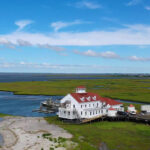
Marine scientists in Tuckerton, N.J., are witnessing firsthand how rising ocean waters will one day permanently shut down their research station. The researchers share their thoughts on eventually losing this critical hub of marine and coastal research in Marine Field Station: The Retreat, a 10-minute documentary made by a Rutgers University-New Brunswick professor and his production crew […]