

The Haskin Shellfish Research Laboratory has played a central role in supporting New Jersey’s oyster industry through decades of research, collaboration, and science-based management. Since 1953, the lab has worked closely with the Delaware Bay oyster industry and the New Jersey Department of Environmental Protection Division of Fish and Wildlife to address challenges affecting oyster […]
Wind Turbines and Fish: Can the East Coast Have Both?

Miles off the coast of New Jersey and New England, two major forces are converging: the rapid expansion of offshore wind energy and some of the most valuable fisheries in the United States. A new editorial published in Fisheries Oceanography takes stock of what we know — and what we urgently need to find out […]
Scientists Prove Shellfish Can Be Farmed Far From Shore
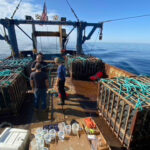
Rutgers researchers have made a discovery that could change the future of seafood farming in New Jersey. A study led by marine scientist Daphne Munroe has shown that Atlantic surfclams can be successfully farmed in the open ocean. Her research, published in the North American Journal of Aquaculture, proves that offshore aquaculture is not only possible but promising. This […]
Scientists Map Genome of Hybrid Oyster to Advance Sustainable Aquaculture
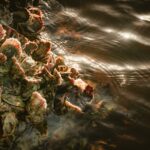
Oysters are one of the world’s most important seafood products, with farms producing about seven million metric tons each year. Now, researchers have unlocked the complete genetic code of a special hybrid oyster, providing a valuable tool that could help improve how these shellfish are farmed. The study, published in Scientific Data, presents the first […]
Keeping Oyster and Clam Farms Safe from Disease

A new study in Aquaculture looked at how tiny oysters and clams (called seed) can carry diseases when moved between hatcheries and farms. The authors wanted to find out which life stages are most at risk, and how careful water treatment can help protect both farmed and wild shellfish. David Bushek, an affiliate of the […]
Rutgers-designed Oyster Reef Structure Installed to Help Protect U.S. Military Base from Storms
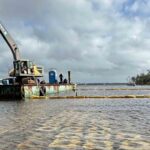
U.S. Air Force officials installed a new kind of structure in the waters of St. Andrew Bay on the shore of the Tyndall U.S. Air Force Base in northwest Florida on Oct. 30 – the first section of a Rutgers University-designed “self-healing” reef made of custom-designed concrete modules and living oysters. The reef is designed […]
Rutgers Haskin Lab Postdoc Collaborates with NOAA Fisheries on Atlantic Surfclam Research
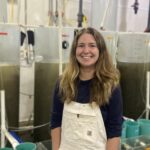
Laura Steeves, postdoctoral researcher at the Haskin Shellfish Research Laboratory, collaborates with NOAA Fisheries to understand how a species important to New Jersey will respond to changing ocean conditions. “The Atlantic surfclam is a shellfish species recognized for their large shells that wash up on beaches along the east coast of the United States. I’ve been […]
Surf Clams Off the Coast of Virginia Reappear – and Rebound
The Atlantic surf clam, an economically valuable species that is the main ingredient in clam chowder and fried clam strips, has returned to Virginia waters in a big way, reversing a die-off that started more than two decades ago. In a comprehensive study of surf clams collected from an area about 45 miles due east […]
Rutgers Shellfish Researcher Investigates the Link between Horseshoe Crabs and Oyster Farming in the Delaware Bay
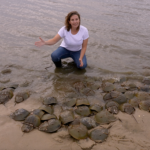
Marine ecologist Daphne Munroe, associate professor in the Department of Marine and Coastal Sciences in the School of Environmental and Biological Sciences, has a deep respect for New Jersey’s Delaware Bay and its unique ecosystem that supports an abundance of life. Munroe, a shellfish researcher working out of the Haskin Shellfish Research Laboratory in Port […]
Rutgers-led Project Successfully Conducts Testing of Shellfish Reef Structure Designed to Promote Coastal Resilience
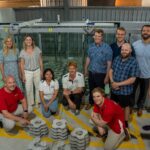
The Rutgers-led Defense Advanced Research Projects Agency (DARPA) project—awarded $12.6 million last fall to develop an artificial reef ecosystem to help project coastlines from storm damage, flooding and erosion—recently conducted laboratory testing of modular oyster reef-mimicking structures for eventual installation in the Gulf Coast. The multi-institution project, “Reefense: A Mosaic Oyster Habitat (MOH) for Coastal Defense,” […]