

Rutgers Cooperative Extension of Middlesex County hosted a workshop with Extension Specialist Joe Heckman demonstrating what it takes to raise a small flock of chickens in a backyard. Heckman offered advice on everything from types of chicken coops to the nutritional benefits of raising food on pasture. The class was one of the first in […]
Home/Lawn/Garden
What Bees Can Teach Us About the Real Value of Protecting Nature
If you ask most experts why we should worry about all those honeybees and wild bees that are famously dying off, they’ll often give a simple answer: because bees pollinate so many of our crops… What’s more, even those wild bees that aren’t pollinating crops at all may still be providing valuable services in the wild- we just haven’t studied those services yet, or slapped a dollar value on it… “If you lost all those pollinators that aren’t pollinating crops, we’d start losing a lot of native plants across Europe and North America,” says Rachel Winfree, an ecologist at Rutgers University and a co-author of the Nature Communications study. “If you start losing a lot of plant species, ecosystems can start collapsing. That can have all sorts of very negative effects, even if we can’t estimate it exactly. We’re only at the beginning of this quantification process.”
Drought: Saving Water with Plant Genetics, Breeding Salt Tolerance
As arid conditions increase in various parts of the nation and world, scientists focus are focusing on using drought-resistant plants and increasing the number of plants able to use treated wastewater that still contains salt. The less water for plants, the more clean water for humans… Researcher Stacy Bonos, at the Department of Plant Biology & Pathology at Rutgers University, and her team recently published their research on perennial ryegrass in Crop Science journal. They’ve found that perennial ryegrass is controlled by additive genetic effects rather than environmental effects, meaning that salt tolerance can be bred for… Bonos’ research team measured salt tolerance using something called “visual percent green color”–the percentage of the plant that is green and actively growing, as compared to brown and therefore dying, according to a release… “It most makes sense…in areas like Las Vegas where there may not be much drinkable water available to water your lawn,” Bonos said in a release. “That’s a prime example.”
Third Graders and the Rutgers Master Gardeners “Seeds to Salad” Team Harvest Bountiful Crops at Whiton Elementary
In mid June the Rutgers Master Gardeners of Somerset County completed their Seeds to Salad program with third graders at Whiton Elementary school located in Branchburg… It took many weeks of preparation to reach the much anticipated “Harvest Day.” In early spring the children planted various types of lettuce, radishes, beets, arugula, Swiss chard, carrots, spinach, onions and were also instructed in how and why it is important to weed, thin and transplant their crops as the plants grew. Master Gardeners also presented weekly lectures about several topics such as soil and soil temperature, “good bugs/bad bugs,” worms, tropism and much more… For many children “Harvest Day” was a highlight as they pulled up all the vegetables they had grown and shortly afterwards enjoyed consuming them at the “Salad Extravaganza”party. The program was a hit with third graders, their teachers and volunteers alike.
Freeholders Praise Master Gardeners of Hunterdon County
The Master Gardeners program of Hunterdon County was praised by the Freeholders, who adopted a resolution honoring the group… Freeholder Director John King presented it at the board meeting Tuesday, June 16. Several volunteers in the program along wi…
From Tree to Greens, a U.S. Open Unlike Any Before
This is a story about countless blades of grass, a single tree and a freight train. Combined, the three will make the 2015 United States Open next week at the Chambers Bay Golf Course in Washington State unlike any played in the previous 120 years of the tournament… Fine fescue is a prized jewel in golf, the carpet beneath the feet of golfers near the game’s Scottish birthplace. But it is also a delicate, persnickety tourist that does not happily acclimate to the customs and climate of most other environs. It struggles to grow in most of the United States… “The shallow roots are ideal for a golf course because it means the fine fescue doesn’t need as much water as other grasses do,” said Dr. William Meyer, the director of the Turfgrass Breeding Project at Rutgers University. “It’s something we’ve perfected.”
Rutgers Master Gardeners of Cumberland County Complete Major Planting Projects
Rutgers Master Gardeners of Cumberland County completed major plantings at the Women’s Heritage Marker, the Global Village Immigrant Memorial, the Meditation Garden at the Seabrook Buddhist Temple, and at the Cohanzick Zoo… On June 10, Master Gardene…
For Wild Bees on Farms, the More the Merrier
Farmers should worry about how many individual wild bees they have pollinating their fields, not how many kinds of bees, according to new research… In their study of fruit plants in New Jersey, Pennsylvania, and California, ecologist Rachael Winfree and her coauthors find that the abundance of a few dominant species of wild bee is more important than the diversity of bee species pollinating crops… “This is not to say that biodiversity is unimportant- far from it,” says Winfree, an associate professor of ecology, evolution, and natural resources in the Rutgers School of Environmental and Biological Sciences.
What’s in Season from the Garden State: The Basil Battle – New Cultivars on the Horizon to Beat Downy Mildew
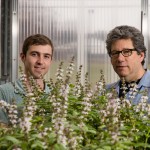
For the past seven years, a familiar scenario has been playing out on farms and in gardens across the U.S. A healthy, fragrant crop of sweet basil begins to display yellowing leaves. Upon closer inspection, the undersides of the leaves show signs of a menacing grayish sporulation. It is only a matter of time before […]
Growing New Jobs in Newark for Veterans [Video]
“There wasn’t a lot of jobs in Newark asking for someone to survey or make maps,” Rutgers graduate Rodney Spencer said. After serving his country in the U.S. Army, Spencer couldn’t find a way to put his skills to use at home. Now he’s a graduate of Rutgers Veterans Environmental Technology Solutions program – an effort to put unemployed vets in the Newark area back to work. “It’s just nice being here, seeing the community connect with a really valuable resource – the returning veterans,” Senior Program Coordinator Jan Zientek said.