
At the annual Rutgers showcase, spectators came to see the running of the horse- on a treadmill. It was one of several exhibits at Rutgers University’s Equine Science Center Summer Showcase at Cook campus Wednesday. The event drew dozens of visitors of…
Commercial Agriculture
Investing in Global Food Security: Doctoral Student David Byrnes Named Kirchner Food Fellow

Rutgers doctoral student David Byrnes has been selected as one of three Kirchner Food Fellows for 2015-2016. The purpose of the Kirchner Food Fellowship program is to foster the development of individuals who have the practical skills and knowledge to make effective investments in emerging agricultural technologies that can address global food security. David Byrnes […]
Open House Attracts 350 Guests
After a day of unrelenting rain, skies cleared on Sunday afternoon (June 28) for the second annual open house at Fair Winds Farm, celebrating the month of the horse in New Jersey. About 350 guests, most of them with no connection or experience with horses, walked up the tree-lined lane, past fields of mares and foals, to the Cream Ridge farm for an afternoon of everything equine… Fair Wind’s Mark Mullen invited several partners and exhibitors to open the doors to the farm and the horse world to the general public, with FFA members parking cars and exhibiting alongside Rutgers University Equine Science program, Harness Horse Youth Foundation, Standardbred Pleasure Horse Organization, NJ Quarter Horse Association, NJ Farm Bureau and Monmouth County 4H, complete with real bunnies in baskets… “It was a beautiful day and we had enthusiastic participation from many groups and a lot of non-horse people here, visiting Dr. Hogan’s clinic, seeing all the demos,” said Fair Winds’ owner Mark Mullen. “People were very complimentary about the farm and all the horses and activities. Everyone seemed to have a wonderful time.”
Food for Thought: Use More Forages in Livestock Farming
Small-scale livestock farming in the tropics can become more intensive yet sustainable if more and better forage is used to feed the animals being reared. This could benefit farming endeavours in rural South Asia, sub-Saharan Africa, Central America and the Caribbean, and see a move away from the increased reliance on grain-based feeds, say scientists at CIAT (International Center for Tropical Agriculture) and Thomas Rudel of Rutgers University in the US, in Springer’s journal Ambio… Rudel and his associates at CIAT argue that the “LivestockPlus” program could be a way forward by increasing the use of forages to feed livestock, which is often reared on small farms, in the tropics. Its agricultural research and extension efforts help to intensify in sustainable ways the management of forage grasses and legumes, shrubs, trees, and animals… “In addition to enhancing the food security of poor consumers by reducing global demand and prices for grains, forage-focused sustainable intensification would improve the productive capacity of poor producers who raise crops and livestock on small landholdings in rural South Asia, sub-Saharan Africa, and Central America.”, says Rudel.
Pollinator Study of Wild Bees Reveals Efficacy in Numbers Vs. Diversity
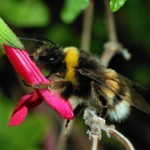
In a study of fruit crops in New Jersey, Pennsylvania and California, SEBS ecologist Rachael Winfree and co-authors from University of Calgary found that the abundance of a few dominant species of wild bees is more important than the diversity of bee species pollinating crops. Read more at Rutgers Today.
What’s in Season from the Garden State: The Basil Battle – New Cultivars on the Horizon to Beat Downy Mildew
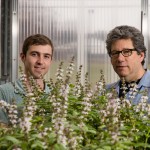
For the past seven years, a familiar scenario has been playing out on farms and in gardens across the U.S. A healthy, fragrant crop of sweet basil begins to display yellowing leaves. Upon closer inspection, the undersides of the leaves show signs of a menacing grayish sporulation. It is only a matter of time before […]
Better Tasting Strawberry Developed at Rutgers Makes Its Debut

It’s been ten years in the making, but the team that has launched the Rutgers Scarlet Strawberry (RSS) knows they have a winner. Coming from retired plant biology professor Gojko Jelenkovic’s 20 years of testing hundreds of varieties to develop a better tasting strawberry, the RSS is the first of several new varieties that are […]
What Was the Key to Rutgers’ Lord Nelson’s Longevity?
What accounted for Lord Nelson’s extraordinary longevity? The world-renowned equine personality, professor and former mounted patrol horse, Lord Nelson died on April 12 at age 42… It’s more than making it to the age of 42- until recently, he was in phenomenal shape for an ancient equine… Dr. Karyn Malinowski, director of Rutgers Equine Science Center who has been responsible for Lord Nelson for the past 37.5 years, gave a lot of credit to his good genes. He was an unregistered quarter horse originally from Oklahoma, and she has no idea of his actual breeding. Besides genetics, Malinowski credits Lord Nelson’s long life to his temperament, management and the fact that he did not completely retire until a few years ago. Lord Nelson was “loyal, fearless and full of attitude,” said Malinowski. “He was bold. He did it his way.”… Although Malinowksi has dealt with many geriatric horses- both personally and professionally- she’s never known a horse to reach the Lord Nelson’s age.
New Jersey Aquaculture Innovation Center Plays Important Role in Oyster Industry [VIDEO]
Oysters are a popular dinner choice near the shore. But before they end up on your plate, and in your stomach, they’re spawned at the New Jersey Aquaculture Innovation Center in Cape May… “Most of the oysters, local oysters that you would buy at a restaurant at any of the Delaware Bay counties, primarily were spawned and started in this facility,” said Sean Towers, of Rutgers NJ Aquaculture Innovation Center… The Center, powered by Rutgers University, does more than selling oysters to local farmers. They’re putting an oyster blueprint together, so others can follow… Right now, the emphasis, is oysters. And algae, the oysters’ diet. But once the oyster blueprint is complete, the focus can shift elsewhere.
Solving the Mystery of Rutgers’ Penalized Horse: Who Should be Saddled With Guilt?
On Wednesday, we brought you the sad news about longtime Rutgers police horse Lord Nelson, who passed away decades after being called for a penalty in a Rutgers-Army game in 1994. But Kevin MacConnell, the former Rutgers associate athletic director for marketing and communications, is “99 percent” sure Lord Nelson wasn’t the equine on the field that day. He says it was a horse from Medieval Times, the theme restaurant that includes jousting tournaments in Lyndhurst… Karyn Malinowski, a professor at the School of Environmental and Biological Sciences animal department, sticks by the story that it was Lord Nelson who was penalized that day. She’s the same person who purchased the horse for Rutgers in 1978 and who later owned him after he retired in 2000. “It was absolutely Lord Nelson,” she said on Friday. “Because I remember seeing the news in The Star-Ledger the next day, that I was very mad at Coach [Doug] Graber’s statements because it wasn’t Lord Nelson’s fault. The rider, somebody asked him to go out on to the field. He didn’t just bolt out on to the field.”