
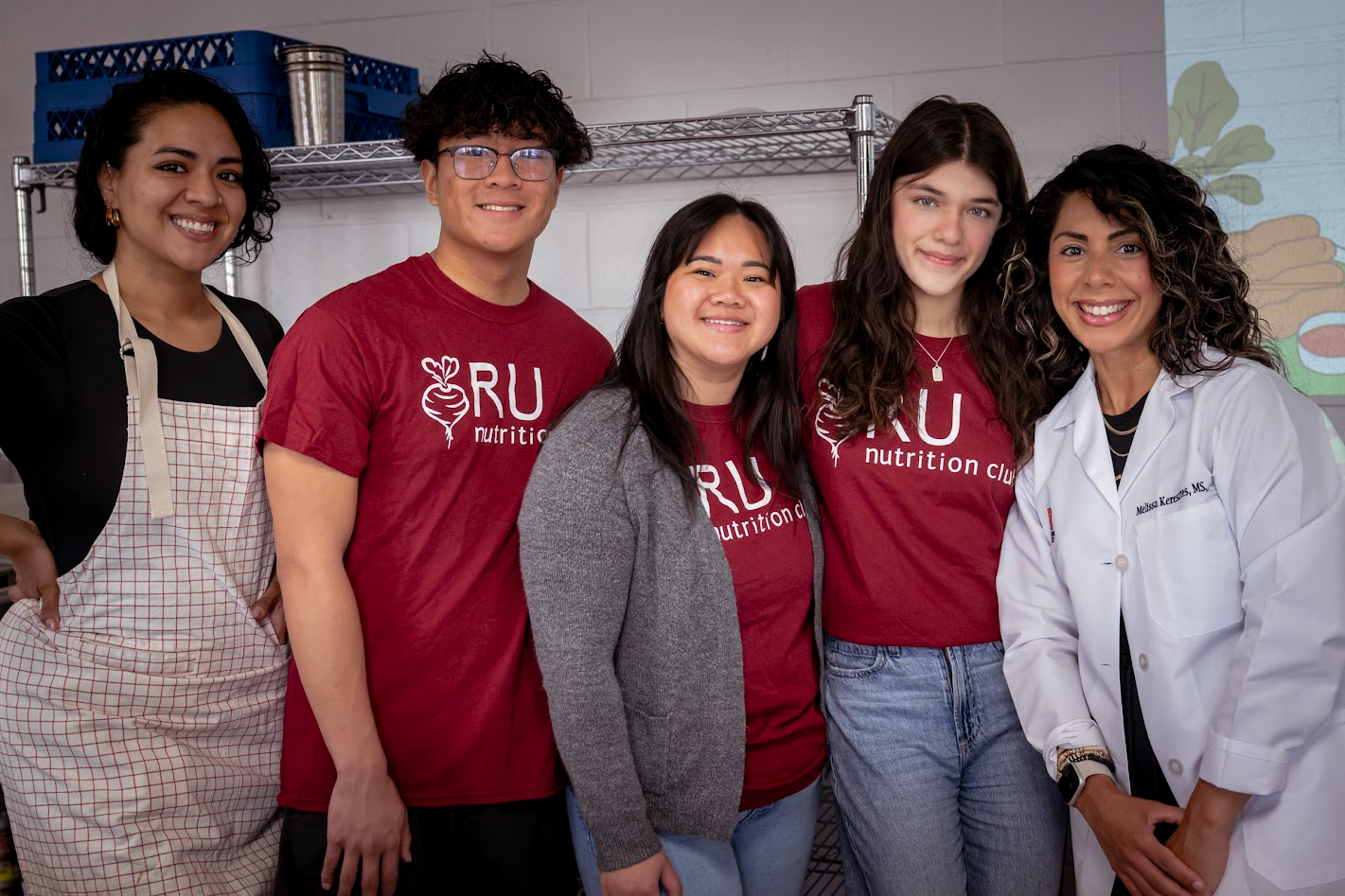
L-R: Nicole Martinez, program coordinator in the Department of Nutritional Sciences; Dustin Nguyen, Salina Hoang and Naiya Bogert, SEBS Nutritional Sciences students; and Melissa Keresztes, lecturer and Foods Lab Coordinator.
Since its renovation and grand opening just over a year ago, the Teaching Kitchen, housed on the second-floor foods lab in Davison Hall on the Cook/Douglass campus, has truly hit its stride. Staying true to the School of Environmental and Biological Sciences (SEBS) mission of hands-on, collaborative learning to life, the space has become a vibrant hub for experiential learning, where students and community members alike engage in cooking, nutrition education and food science exploration.
“Our renovated Teaching Kitchen has really energized our nutritional sciences program,” said Josh Miller, professor and chair of the Department of Nutritional Sciences. “We can now provide our students with engaging experiential learning opportunities in a state-of-the-art facility, and we can offer a variety of opportunities for community engagement, such as culinary health classes.”

Melissa Keresztes, lecturer and Foods Lab Coordinator with a young visitor to the Teaching Kitchen during SEBS’ Bring Your Child to Work Day in April.
“I’m excited at the opportunity to oversee this state-of-the-art Teaching Kitchen and solidifying its role as a ‘hotbed of experiential learning’ and a cornerstone of SEBS’s commitment to immersive, real-world education,” said Melissa Keresztes, lecturer and Foods Lab Coordinator.
The past year has been a period of intense growth for the Teaching Kitchen, which has hosted a diverse range of programs and events that showcase innovation, collaboration and impact.
The annual “Bring Your Child to Work Day” on the Cook campus in April featured a Power Up with Protein session that enabled the Teaching Kitchen to showcase its mission to blend community engagement with experiential learning. Led by three dedicated dietetics students, the event offered children a fun, hands-on cooking experience while giving undergraduate students valuable practice in nutrition education, program planning and leadership.
“This milestone moment highlighted how the Teaching Kitchen is transforming classroom knowledge into real-world impact for both students and the broader Rutgers community,” said Keresztes.
Dustin Nguyen SEBS’27 is a junior and a Nutritional Sciences major.

NextGen Bergen Community College experimental learning experience picking blueberries at the Rutgers Philip E. Marucci Center for Blueberry and Cranberry Research and Extension in Chatsworth, NJ.
“When I first started learning in the new teaching kitchen introduced last year, I was exposed to new and different ways food could be applicable to my everyday life, as well as my field of study. I was exposed to an environment where collaboration in nutrition was encouraged. I hope many more students can experience this kind of experiential learning!”
A sophomore and Nutritional Sciences major, Naiya Bogert SEBS’28, is one of those students.
“Working in the teaching kitchen has deepened my understanding of nutrition by allowing me to apply the skills I’ve learned in my coursework. It has also shown me how a hands-on, culinary approach can make teaching and sharing nutrition more engaging and impactful.”
In June, a dynamic collaboration between the Nutritional Sciences Teaching Kitchen and the Plant Biology Department united students from Bergen Community College and SEBS through the USDA-funded New Jersey NextGen for Sustainable Farming initiative. This collaboration enabled a full-day, hands-on learning experience—from blueberry picking at the Rutgers Philip E. Marucci Center for Blueberry and Cranberry Research and Extension in Chatsworth, NJ, to cooking and nutrition science experiments in the Teaching Kitchen—students explored the intersection of agriculture, food science and health.
“The program strengthened interdepartmental collaboration and exemplified SEBS’s commitment to experiential learning, innovation and community partnership,” explained Keresztes.
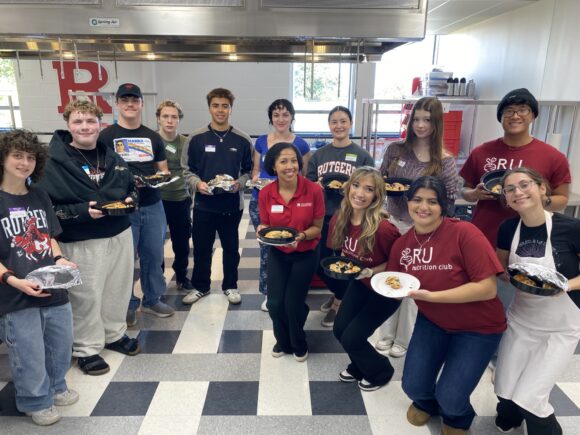
Students of the SEBS Guided Gap Semester Program and Nutrition Club.
The GEAR UP Summer Program, a four-week culinary nutrition series held in July into August, introduced middle school students from New Brunswick to college life and hands-on learning in the Teaching Kitchen.
“Through interactive lessons on seasonal produce, hands-on cooking and food science activities, students gained confidence, curiosity and an appreciation for healthy eating and sustainability,” said Keresztes.
The program also provided valuable experiential learning and leadership opportunities for undergraduate dietetics students, highlighting the Teaching Kitchen’s growing impact in community engagement and education.
Rounding out an active year of activities, in October the Guided Gap Semester – Nutritional Sciences Program offered incoming SEBS students an engaging introduction to the field of Nutrition and Dietetics through hands-on learning and peer connection in the Teaching Kitchen. Participants explored career pathways, baked fresh scones alongside current students, and experienced the collaborative, supportive environment that defines the Department of Nutritional Sciences. This event welcomed future students to campus life and showcased the Teaching Kitchen as a dynamic space for mentorship, experiential learning and community building within SEBS.