
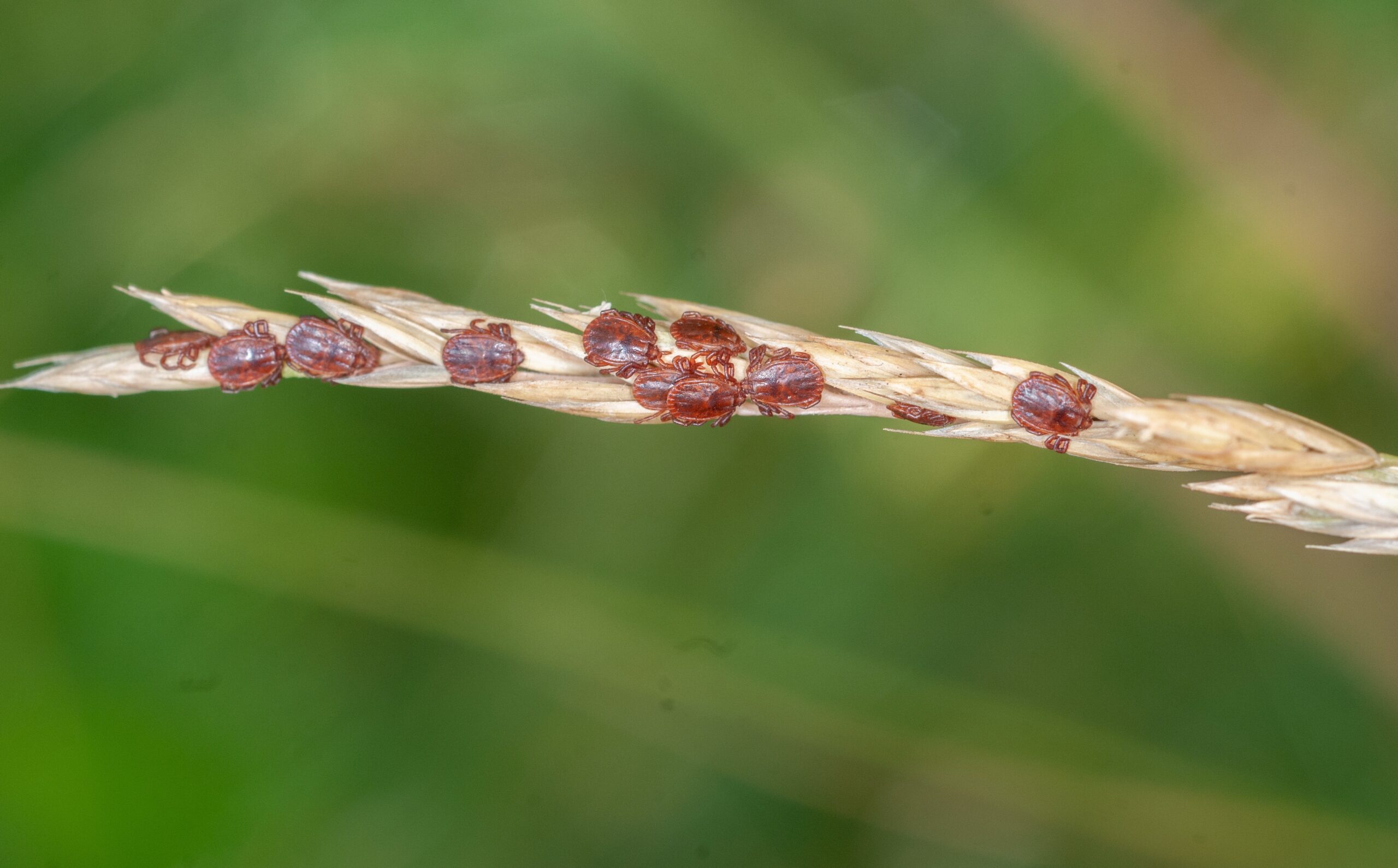
Adult female Asian longhorned ticks attached to vegetation and waiting for a host to come by. Photo: Jim Occi.
A pair of new studies led by researchers at the Rutgers Center for Vector Biology use genetic data to help trace the potential routes of introduction of the invasive (ALT), Haemaphysalis longicornis, into the United States, and to identify potential vaccine targets within the tick that can be exploited to protect vulnerable livestock populations.
While this tick is native to China, Japan and the Republic of Korea, one lineage in particular is rapidly spreading through multiple countries, including Australia, New Zealand and various Pacific Islands. This lineage has the rare ability to reproduce without the presence of male ticks, a phenomenon known as parthenogenesis.
In 2017, the presence of parthenogenetic Asian longhorned ticks in the U.S. was first reported in New Jersey, said Dana Price, assistant professor in the Department of Entomology. However, historical samples have now shown evidence of the ticks’ establishment as early as 2010 in West Virginia. As vectors of Theileria orientalis—a parasitic livestock pathogen—H. longicornis poses a substantial threat to U.S. livestock.

Assistant professor Dana Price in the lab.
In the first study, published in Ecology and Evolution, researchers led by Price and doctoral student Zoe Narvaez, utilized genome sequence data from the tick’s mitochondrion (or mitogenomics) to determine the source and frequency of ALT introductions to the U.S. By comparing DNA from hundreds of Asian longhorned tick samples from different regions in the U.S. to those of native and invasive samples from East Asia and Oceania, the authors were able to determine that there were very likely at least four separate introduction events to the United States from particular regions in Japan and the Republic of Korea.
Global economic losses due to tick-borne diseases are estimated at $22-30 billion annually. To mitigate such huge losses, chemical acaricides are routinely used to control ticks, including ALT, on and around livestock, companion animals, and humans. Reliance on chemical treatments alone can result in the development of resistance in tick populations. Vaccines administered to animal hosts (cows, for example) that prime the host immune system to generate “anti-tick antibodies” that are in turn delivered to the tick as it feeds on host blood represent novel and emerging tools for tick control in conjunction with acaricide treatments.
In their paper published in BMC Genomics, Price and postdoctoral research associate Mohamed Moustafa, in conjunction with collaborators at USDA-ARS and Texas A&M AgriLife Extension Service, sequenced the complete genome of North American H. longicornis ticks and screened more than 21,000 of its genes to identify those that the cattle immune system would recognize as “foreign” (or antigenic) to induce antibody production.
The Price lab has currently moved four such genes to the next step in the process, which involves assessment of reproductive capacity and/or morbidity in the tick when each gene is silenced using RNA interference.
“These studies are a critical step toward protecting livestock producers in the United States,” said Price. “By tracing the origins of this invasive species and identifying genetic weak points to exploit with emerging technologies, we’re developing tools that could ultimately transform how we manage ticks and the diseases they carry.”
References:
Narvaez, Z.E., Egizi, A.M., Yabsley, M.J., Thompson, A.T., Moustafa, M.A.**, Alt, E., Bickerton, M., Bjorgo, K., Butler, R.A., Cumbie, A., Eastwood, G., Falco, R.C., Fonseca, D.M., Hang, J., Harper, V.L., Lewis, N., Lovy, J., Maestas, L.P., Mather, T.N., Nakao, R., Occi, J.L., Rainey, T., Sal, M., Stoops, C.A., Trout-Fryxell, R.T., Watson, W., Wagner, N.E., Zheng, A., Saelao, P., & Price, D.C. (2025). Multiple introductions of the Asian Longhorned Tick (Haemaphysalis longicornis) to the United States revealed using mitogenomics. Ecology and Evolution, 15(4): e71312, 14pp. https://doi.org/10.1002/ece3.71312
Moustafa M.A., Barnes M.M., Wagner N.E., Bodine D., Bendele K., Teel P.D., Saelao P., Price D.C. (2025). Genome of the invasive North American Haemaphysalis longicornis tick as a template for bovine anti-tick vaccine discovery. BMC genomics, 26(1):307.