

Faculty and staff from Rutgers Department of Animal Sciences and Rutgers Gardens gathered with undergraduate and graduate student mentors and incoming cohort of students from LAGCC, OLLU, Texas State, Bergen County College and UPR for USDA NIFA NEXTGEN Animal Science Discovery Program on June 22 at Cook Campus Center MPR.
New Sustainable Urban Agriculture track, expanded student cohort and growing institutional partnerships highlight the USDA-funded initiative preparing the next generation of agriculture professionals.
The USDA NIFA NEXTGEN Animal Science Discovery Program (ANSCId) concluded its third summer on July 10 with a closing ceremony at the Douglass Student Center, Trayes Hall, on the Rutgers–New Brunswick campus. The intensive residential experience served 36 students across three experiential learning tracks while bringing together faculty, mentors and leaders from partner institutions across the country, underscoring the program’s growing national reach.

Animal Science Discovery Program students with horse from the RU Teaching Herd.
Now in the third year of its five-year, $4.5 million USDA NIFA NEXTGEN award, ANSCId is a joint initiative between LaGuardia Community College (LAGCC)—a federally designated Hispanic-serving institution within the City University of New York system—and Rutgers University. Through immersive experiential learning, research, and mentoring, the program prepares a highly skilled workforce for careers in agriculture, food systems, veterinary medicine, and related sciences. It creates an educational pathway from New York City high schools to LAGCC and ultimately Rutgers, providing under-resourced students opportunities to pursue careers in the food, agriculture, natural resources and human sciences (FANH) workforce.
“Each year we see students arrive unsure whether there is a place for them in this field, and leave knowing that there is,” said Aparna Zama, ANSCId Project Director and teaching professor and director of the undergraduate program in animal sciences at the Rutgers School of Environmental and Biological Sciences (SEBS). “Watching that transformation happen for a third cohort—and now across three different tracks—tells us that this model works.”
Preethi Radhakrishnan, ANSCId PI/Project Director at LAGCC noted that “this pipeline model has led to the first ever animal science major being established in NYC. Over 200 students are now enrolled in the environmental science major-animal science track at LAGCC.” Ten students have transferred from LAGCC to Rutgers University on ANSCId scholarships with one student graduating in January 2026, three more expected to graduate in Spring 2027, and six others by Spring 2028.
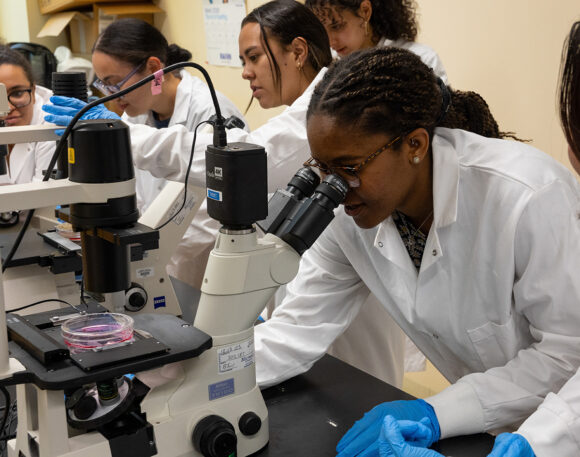
Students participating in cell and tissue culture labs in Foran 104.
ANSCId was launched in 2024 with two tracks—the Summer Experiential Learning Program (SELP) and the Summer Undergraduate Research Experience (SURE). This year it added a third, Sustainable Urban Agriculture (SUA), expanding its focus to include community gardens, urban food production and food security.
“I’m so glad Rutgers Gardens was able to host the urban agriculture pilot program,” said Lauren Errickson, director of Rutgers Gardens and Campus Stewardship. “Connecting students and community members around food and gardening is at the core of our work at Healthy Harvest, and it was wonderful to have the LAGCC students make meaningful contributions alongside our team while gaining hands-on learning experience.”
Assistant director, Meagan Terry, added “The LAGCC urban agriculture students jumped right in with our teams on both the Rutgers Gardens Student Farm as well as our Healthy Harvest urban agriculture expansion of both the community garden and in-ground food production. Through rain, extreme heat, and everything-in-between they displayed positivity, tenacity, and grit alongside our crew seven hours each day. We are grateful for their contributions to expand our growing areas with Healthy Harvest, and for participating in all farm activities during their three weeks. We hope to continue learning from each other and stay connected as they progress in their urban agriculture journey”.
This summer’s cohort included 29 students in SELP, four in SURE and three in the inaugural SUA track. Participants explored veterinary and human health careers through anatomy laboratories, animal handling and husbandry, cell culture, laboratory and field research, sustainable urban agriculture, community gardens and farmers market operations. All three tracks incorporated USDA workforce development activities, including résumé writing, interview preparation and career exploration.

From left to right, Ed Sanchez (BCC), Aparna Zama (Rutgers), Douglas Morrish (Texas State University), and Chuck Keeton (Vice Provost of Experiential Learning, Rutgers-New Brunswick).
A hallmark of the program’s growth this year was the participation of students and faculty from Our Lady of the Lake University, Texas State University, the University of Puerto Rico, and Bergen Community College. Speakers at the closing ceremony included Doug Morrish, associate dean for Student Success in the College of Science and Engineering at Texas State University and project director of the Texas State RAISE NEXTGEN grant, and Edward Sanchez, project director of the Bergen NEXTGEN Program for Food and Agricultural Sciences. Their participation reflected ANSCId’s growing role within a national network of institutions preparing the next generation of agriculture professionals.
Morrish said, “We were honored to participate in the USDA NIFA NEXTGEN Animal Science Discovery Program offered by Rutgers School of Environmental and Biological Sciences. This program provided six Texas State University Department of Agricultural Sciences students with an exceptional experiential learning opportunity. Through hands-on exposure to animal science research, industry innovation, and career development, these students gained valuable skills and professional networks that will help prepare them to become the next generation of leaders in agriculture. This investment by USDA NIFA strengthens our commitment to developing a highly skilled agricultural workforce capable of addressing the evolving challenges and opportunities facing animal agriculture.”
“Animals are special creatures who need special people to understand and care for them,” said Sanchez. “The Rutgers Animal Science Discovery Program successfully united a cohort of students with the compassion to provide that care. They are the next leaders in animal stewardship.”
Morrish and Sanchez were joined by Rutgers leaders Laura Lawson, Executive Dean of SEBS; Ann Gould, Dean of Academic Programs at SEBS; Chuck Keeton, Vice Provost of Experiential Learning at Rutgers–New Brunswick; and Carolyn Moehling, Senior Vice Provost and Vice Chancellor for Undergraduate Education at Rutgers–New Brunswick.
“The students had incredible experiences and learned so much about animal science as a field and a career,” said Keeton. “They worked really hard and flourished thanks to support and encouragement from many Rutgers faculty, staff and students. All in all, this program is a model of immersive, hands-on learning.”
Christopher Nytch, project director of the IINSTAR-AS NEXTGEN Project at the University of Puerto Rico, said, “We are thrilled and appreciative that two undergraduate fellows from the IINSTAR-AS project at the University of Puerto Rico-Río Piedras Campus could participate in the Summer 2026 Animal Science Discovery Program at Rutgers University. The experience provided unmatched practical training in animal sciences, offering a unique perspective that enriches our students’ academic journeys in environmental sciences and directly aligns with the goals of the USDA-NIFA NEXTGEN program.”
With three established learning tracks, expanding institutional partnerships and a growing network of NEXTGEN collaborators, ANSCId enters the second half of its USDA NIFA award positioned to deepen its impact. The initiative reflects Rutgers’ commitment to experiential learning, interdisciplinary collaboration and preparing a workforce equipped to address the future challenges of FANH careers.
“This is bigger than any one campus,” Zama said. “It takes faculty, staff, undergraduate peer mentors, graduate student mentors, community college partners, and now sister programs in other states all pulling together in the same direction. We are grateful for the continued funding from USDA NIFA, which supports American farmers, ranchers and producers while strengthening veterinary education and biomedical research.”
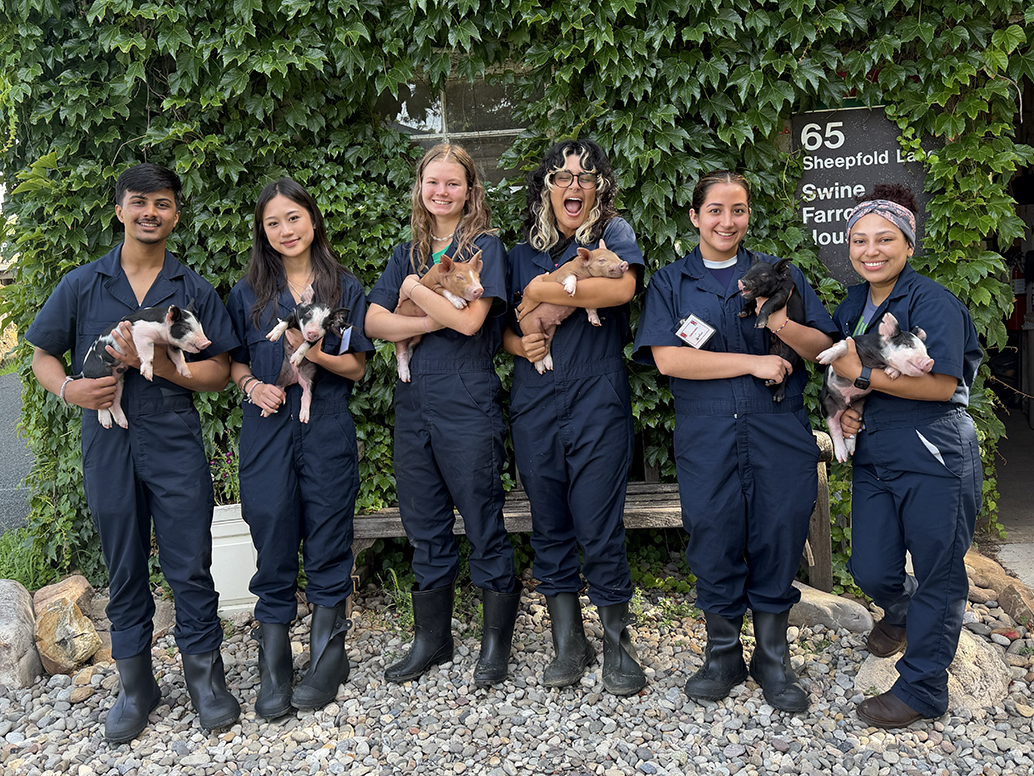
Students holding piglets in front of the farrowing house at the Rutgers Farm.
ABOUT ANSCId
The Animal Science Discovery Program (ANSCId) is a five-year, $4.5 million initiative funded by the USDA National Institute of Food and Agriculture (NIFA) under its “From Learning to Leading: Cultivating the Next Generation of Diverse Food and Agriculture Professionals” (NEXTGEN) program. A partnership between LaGuardia Community College and Rutgers University–New Brunswick, ANSCId provides paid experiential learning, transfer scholarships, peer mentoring, and career development to build a pipeline of professionals in animal science and related fields. ANSCId is one of 33 programs funded under the USDA-NIFA NEXTGEN initiative, a $262.5 million investment supporting training for more than 20,000 future food and agricultural leaders nationwide. At Rutgers, the program builds on an articulation agreement that allows LAGCC students who earn an associate’s degree in environmental science with an animal science focus to seamlessly transfer and complete an undergraduate degree in animal sciences. The program also supports its participants through ANSCId scholarships for LAGCC students, reinforcing the transfer-and-completion pipeline at the heart of the initiative.