
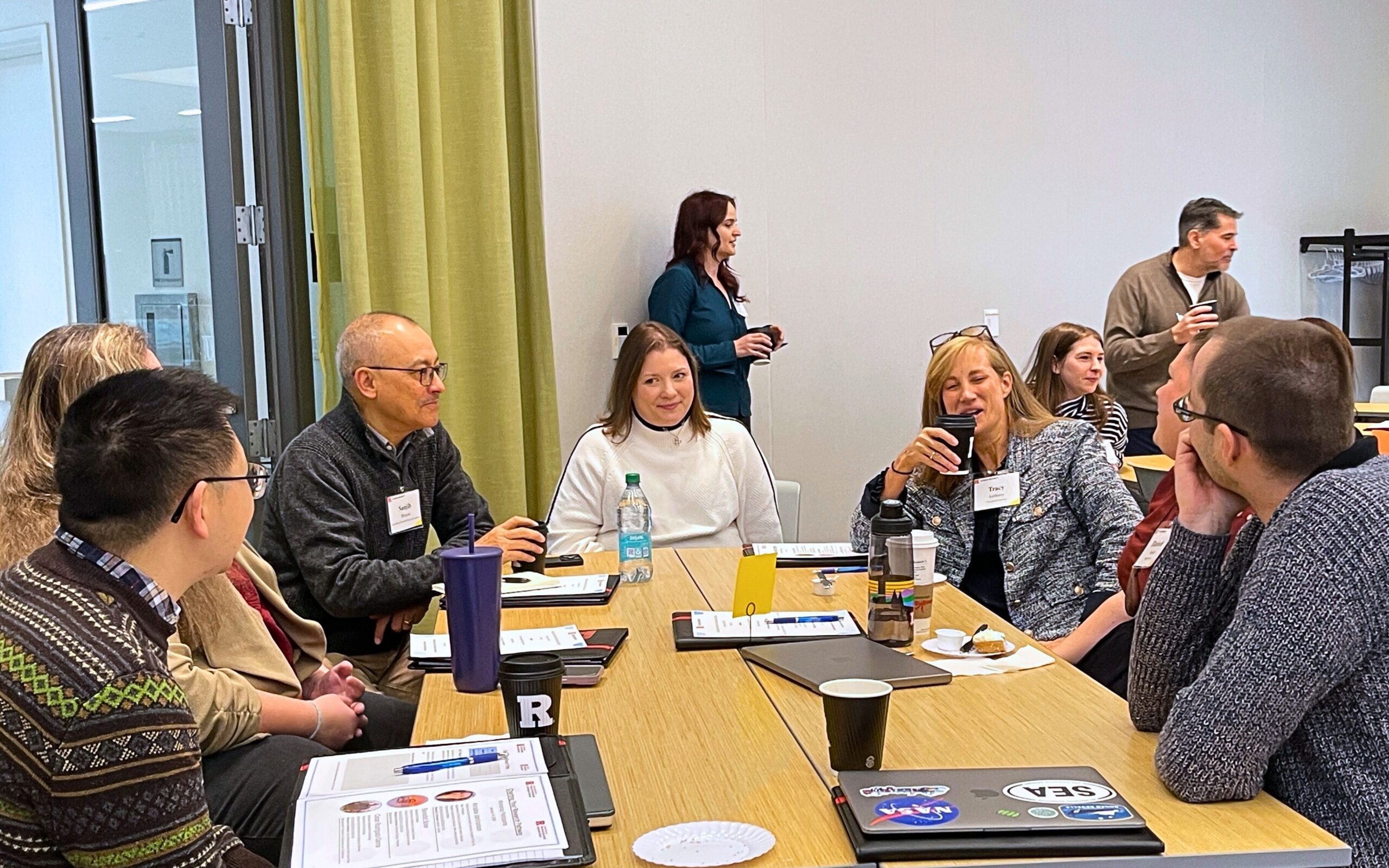
Attendees in the SEBS Office of Research’s inaugural “Charting a Research Pathway” event, get to know each other, discussing their field, research and impact work.
Faculty from SEBS and NJAES gathered on Rutgers’ Cook Campus in January to kick off a dialogue that the SEBS Office of Research hopes will lead to an increase in the high-quality, cross-disciplinary research at Rutgers that often significantly impacts the state and our society, at large.
The in-person event was the kickoff of the office’s inaugural “Charting a Research Pathway” series. Over the next few months, more than 35 faculty members will delve into their own research vision, understand where their own career hopes and goals intersect, and collaborate across disciplines to develop transdisciplinary research efforts that address various impact areas.
Attendees get to know each other, discussing their field, research, and impact work.
By design, this workshop series will position SEBS/NJAES research and extension faculty to find maximum synergy. Together, they will leverage each other’s expertise and networks to develop research plans that have both a high standard of quality research and societal impact.
“Research and Extension are not two separate activities,” said Josh Kohut, dean of research at SEBS and director of research at NJAES. “We are meant to do this work together.”
In undertaking this work, faculty attendees hope to position themselves strategically in the currently shifting research landscape. This landscape was elucidated by the workshop’s various speakers, including Brian Schilling, director, Rutgers Cooperative Extension; Dominique Carter, Ph.D. of Lewis-Burke Associates; George LeBlanc, vice president for government and fiscal affairs in the Department of Government Relations at Rutgers; and Kay Bidle, professor, Department of Marine and Coastal Sciences.
At this kickoff, attendees received advice on how to be more proactive in their research pursuits. In frank and informative talks, both Carter and LeBlanc discussed how the national and state research priorities are shifting focus toward use-inspired research, as well as how SEBS and NJAES faculty can respond.
Both speakers emphasized a focus on societal impact in conjunction with their research. They also noted how the funding calls from some government agencies increasingly look for cross-disciplinary teams to undertake large, highly impactful research.
“Finding research funding can be challenging, but those challenges often spark the clarity needed to refine a powerful research vision. Through this workshop series, we’re helping faculty turn the funding landscape into an opportunity. We want SEBS faculty to have an opportunity to articulate their goals, strengthen their ideas, and position their work for the greatest impact “said Janice McDonnell, SEBS Associate Dean of Research Impact.
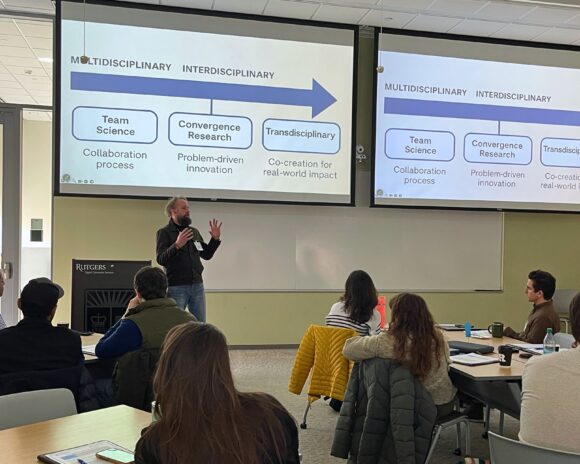
Kay Bidle, professor, Department of Marine and Coastal Sciences, described his team’s research approach to “Convergence Research.”
McDonnell notes “identifying the right funding can be a challenge, but it’s also a meaningful step toward building a research vision that aligns with our land grant mission. Through this workshop series, we’re helping faculty transform the search for resources for long-term transdisciplinary impact.”
This was further stressed by Bidle. At Rutgers, he has pursued an area of research prioritized by NSF called Convergence Research—an idea that became of interest to several attendees.
“In convergence research, cross-discipline co-creation is absolutely essential,” Bidle said, as he explained the cross-field interconnected nature of his research group. He attributed closely integrated, cross-field collaboration and incubation as essential to the new discoveries found within the project. “That’s the type of thing NSF is looking for in funded projects tackling grand challenge questions.”
“I really want to make this happen in my world,” said Elizabeth Snyder, associate professor, Department of Animal Sciences, who attended the workshop. Snyder is looking forward to convening a team within her department and beyond to develop a convergence research approach.
As the workshop series progresses, attendees will have the opportunity to explore research questions that will require collaboration between fields from the start. They will also gain more insight into federal, foundation, and industry funding opportunities. In the end, they will work in cross-disciplinary teams to develop their own transdisciplinary concept paper ready for funding calls.
For faculty interested in developing their research impact potential, please contact Janice McDonnell, Associate Dean of Research Impact at SEBS, at mcdonnel@marine.rutgers.edu.