
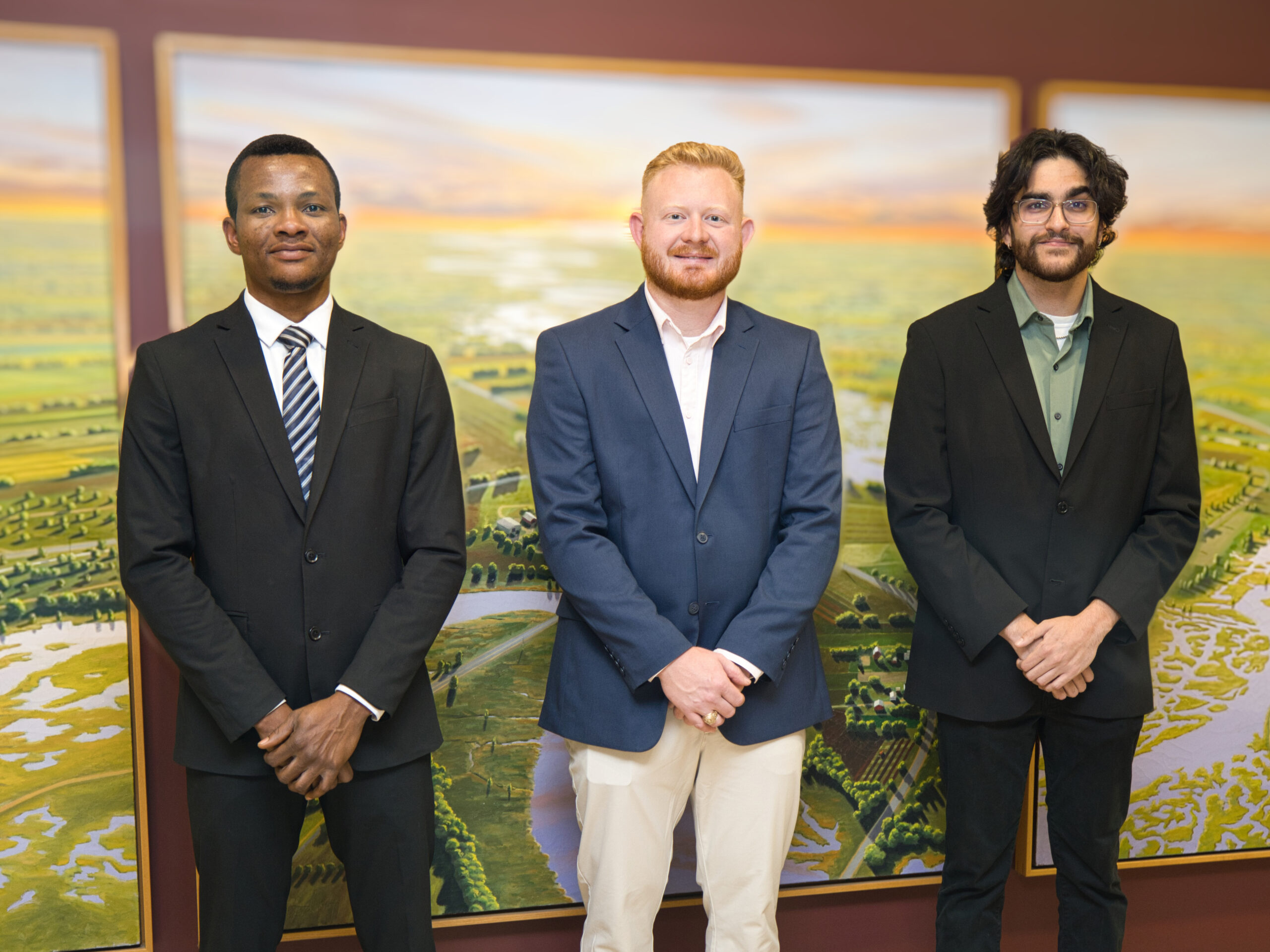
L-R: Award-winning Plant Biology graduate students Emmanuel Nwachukwu, Ryan Earp and Devan Gladden. Photo: Susane Ruemmele.
Leaders in agronomy, crops and soil sciences gathered at CANVAS 2025 from November 9-12 in Salt Lake City, Utah, to host the premier gathering of ideas, solutions and innovation from across the field of environmental sciences. CANVAS, formerly the ASA, CSSA, SSSA International Annual Meeting, provides a platform for emerging learners and leaders from industry, government agencies, and academic institutions to explore advances in agronomic, crop and soil sciences.
Under the theme, “40 Years into the Future,” CANVAS 2025 offered scientific sessions, workshops, poster sessions, an exhibit Hall, and student-focused programming that ensured numerous opportunities for students pursuing studies in these fields.

Graduate student Ryan Earp. Photo: Susanne Ruemmele.
Among the emerging leaders were three graduate students in the Department of Plant Biology at the School of Environmental and Biological Sciences, who won awards for their poster presentations.
Ryan Earp won first place in the Turfgrass Breeding, Genomics, Physiology and Molecular Biology poster session for “Determining DNA Content and Ploidy Variation in Kentucky Bluegrass Cultivars and Accessions Using Flow Cytometry,” which he coauthored with Chris Tkach, Christine Kubik, Jennifer Vaiciunas, Mark LaBarge and Stacy Bonos.
“This year, my poster focused on developing a high-throughput flow cytometry method to accurately determine ploidy levels in Kentucky bluegrass. Because this species is highly polyploid and extremely variable, reliable ploidy estimates are essential for fully understanding the genetic analyses for my overall project,” said Earp.
“Receiving the award was truly an honor. This project required a lot of trial-and-error, so it was very rewarding to see that effort recognized. It also reinforced the importance of building strong foundational methods, not just focusing on the final results,” he added.
Earp is no stranger to this national industry event.

Graduate student Devan Gladden. Photo: Susanne Ruemmele.
“As a repeat presenter and previous award recipient, it has been exciting to show how my research is progressing from year to year. Last year’s project centered on building the bioinformatics pipeline for SNP discovery in Kentucky bluegrass, and this year’s work adds the cytogenetic framework needed to interpret those data. Presenting again allowed me to demonstrate how these pieces connect and how each step moves the overall project forward. I’m grateful for the continued support and motivated to keep advancing this research.”
Devan Gladden won second place in the Turfgrass Water Conservation poster session for “High Throughput Phentoyping of Stay-Green Traits for Kentucky Bluegrass Under Variable Irrigation,” which he coauthored with Stephanie Rossi and Bingru Huang.
“The research I presented is a comparison of using drone imaging versus more manual techniques like sampling, imaging, and rating each sample plot of turfgrass in response to watering that simulates varying levels of drought. The division I competed in was turfgrass water conservation and this research utilizes newer technology to help reduce labor and costs associated with breeding drought tolerant plants with reduced irrigation requirements, helping conserve water. I was pretty excited and surprised to have placed as this was my first time going to a research conference let alone presenting in two student competitions,” said Gladden.
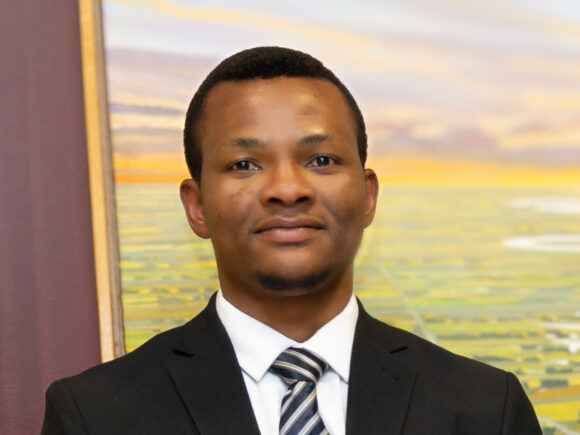
Graduate student Emmanuel Nwachukwu. Photo: Susanne Ruemmele.
Emmanuel Nwachukwu won third place in the Golf Turf Management and Remote Sensing poster session for “Influence of Soil pH Gradient on an Annual Bluegrass Putting Green,” which he coauthored with James Murphy and Matthew Elmore.
“Our research revealed that during stressful summer times, turf quality of Poa annua putting green did not decline in mat layer acidic pH when supplemented with gypsum and nitrogen. I feel happy to assist golf course superintendents in their fertility programs,” said Nwachukwu.