
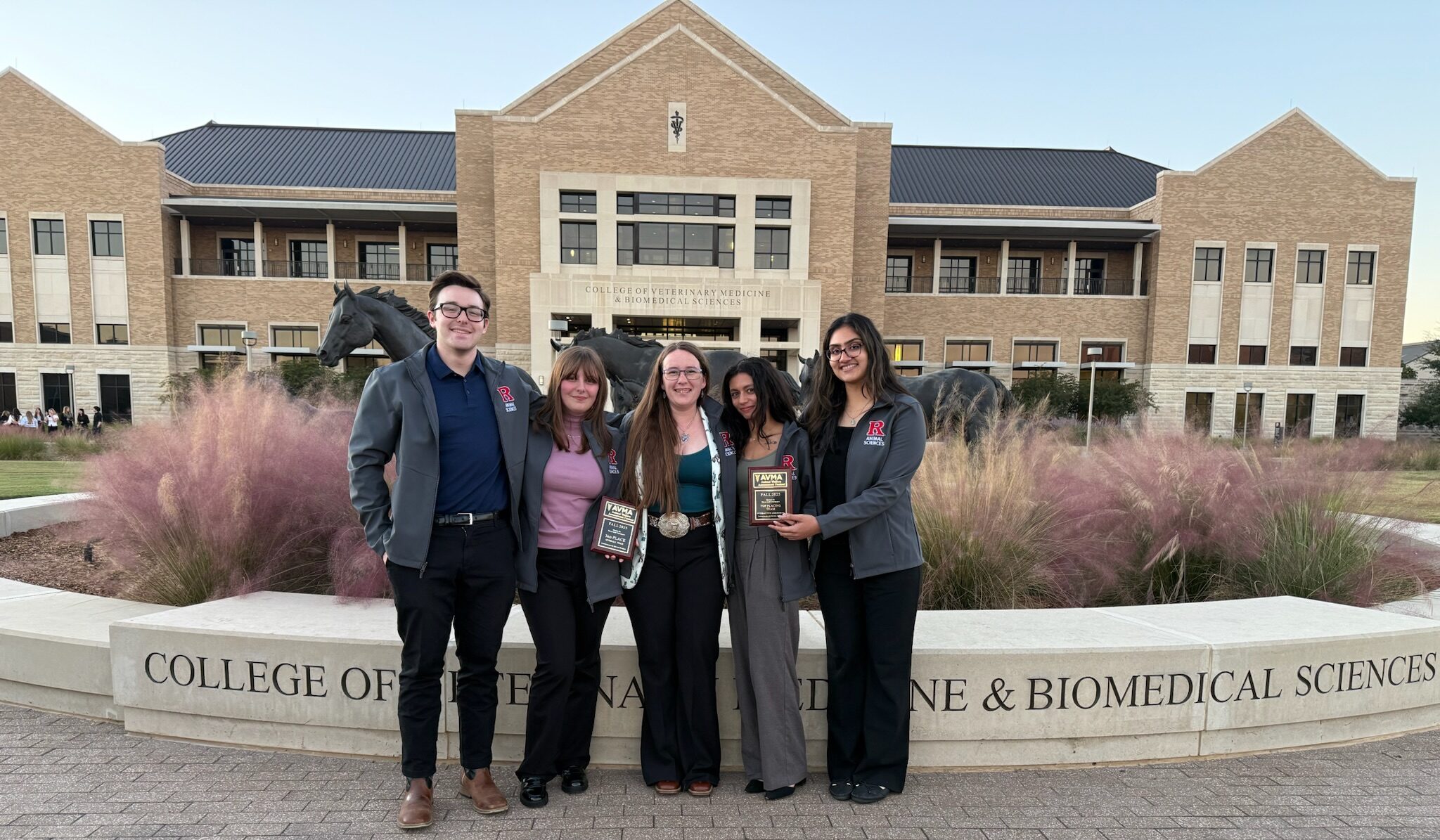
The Rutgers Animal Welfare Judging Team with their awards at the Texas A&M College of Veterinary and Biomedical Sciences campus. L-R: Jacob Bazer, Courtney McCarroll, Coach Dr. Taylor Ross, Aditri Singh, and Sakhee Daga.
The Animal Welfare Judging & Assessment Competition (AWJAC) is a national, intercollegiate event that challenges students to evaluate the welfare of diverse animal species using science-based criteria. Competitors assess real-world management scenarios, score facilities, and deliver oral reasons defending their decisions. This year’s contest, hosted at Texas A&M University, featured one of the largest turnouts, to date.
After months of work, the Rutgers team of animal sciences undergraduates earned exceptional results, placing first overall in the Live Assessment and third overall as a team in the undergraduate senior division. The team handily won the Live Assessment by more than 15 points.
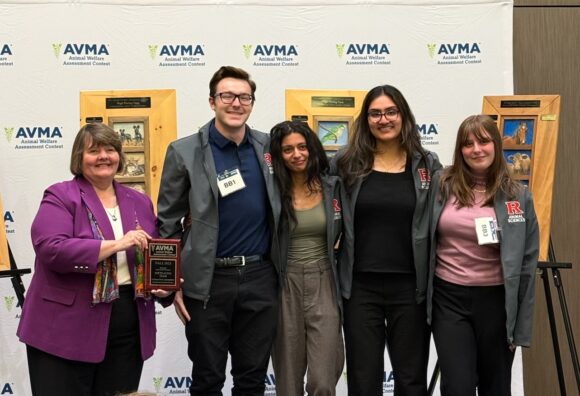
Rutgers receiving the Top Team in the Undergraduate Senior division award. Pictured from left to right are AVMA’s Dr. Gail Golab and Rutgers team members, Jacob Bazer, Aditri Singh, Sakhee Daga and Courtney McCarroll. Photo credit: Taylor Ross
This fall marked Rutgers’ second time attending the Fall Live, in-person contest, having first begun competing in Spring 2024. Despite being a relatively new program, Rutgers has consistently placed alongside — and often above — universities that have been competing for decades. The team looks forward to continuing to push the potential of this growing program.
Individually, Aditri Singh placed 10th overall, also earning the highest score in the entire competition in the pet gerbil scenario, followed by Jacob Bazer in 28th, Sakhee Daga in 33rd, and Courtney McCarroll in 37th, with all four team members finishing in the top half of a highly competitive division.
This year, competitors evaluated three species categories: gaboon vipers in zoos, dressage horses, and pet gerbils, in addition to an in-person live assessment of tilapia aquaculture. Preparation for the competition began early in the semester and involved intensive team practices focused on species-specific welfare science, facility analysis, ethical frameworks, and repeated oral reasons drills.
Students also took field trips to real-life facilities, attended guest lectures from industry and academic professionals, and reviewed current research to ground their evaluations in evidence-based welfare principles. During the competition weekend, students also participated in a formal networking event and attended keynote presentations from leading animal welfare scientists, further enriching their learning experience.
The team extends its appreciation to the facilities that hosted them during their preparation, the professionals who provided guest instruction, the generous donors and the Department of Animal Sciences who support their travel and training. Teaching instructor Taylor Ross served as team coach and her guidance was instrumental to this year’s success. The team is looking ahead to the Spring contest with enthusiasm and continued dedication to advancing animal welfare knowledge, scholarship and leadership within the program.