
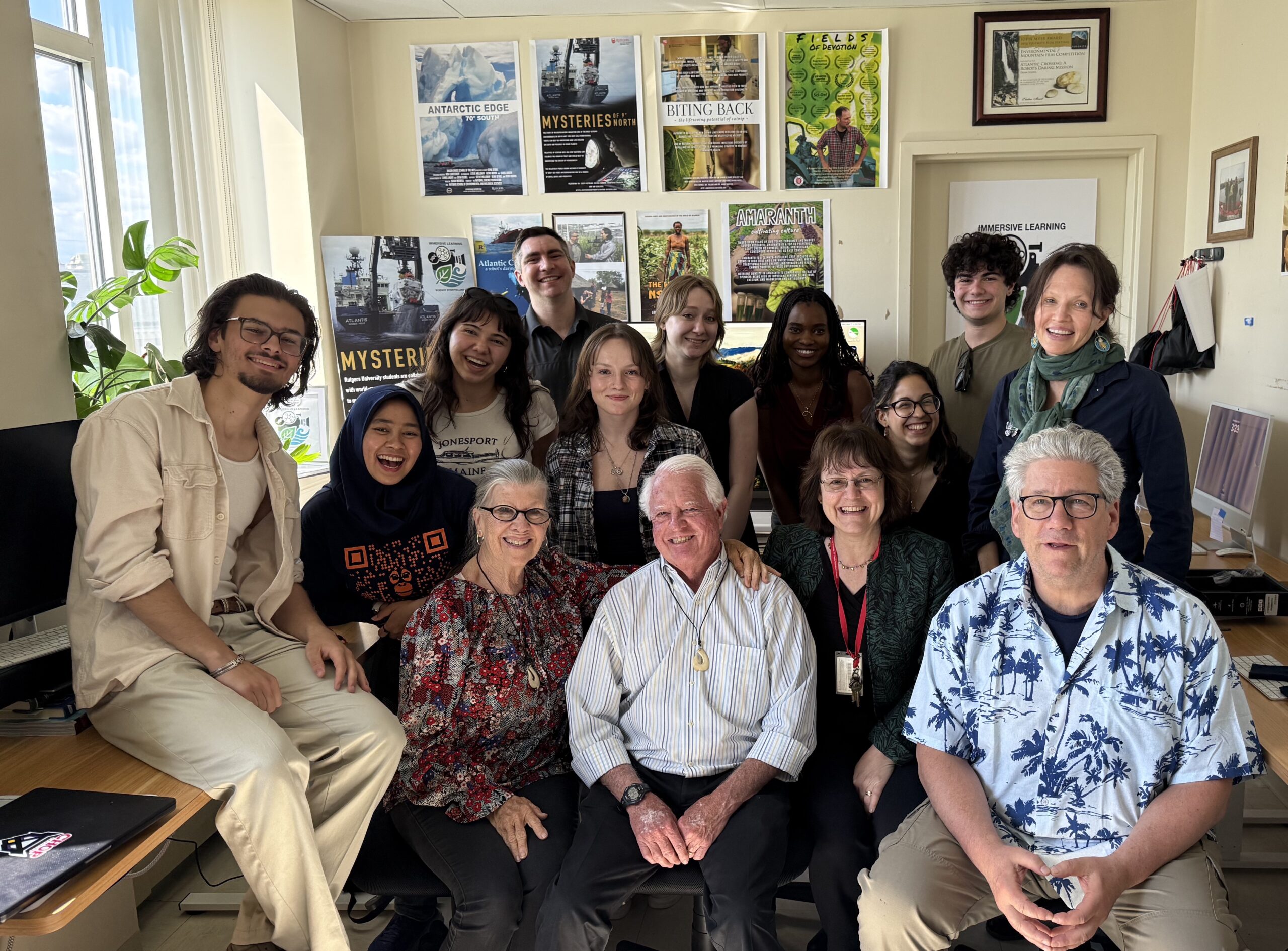
Donors Don and Penny Pray, seated at the center, visit the storytelling lab. Photo credit: The Storytelling Lab.
The Rutgers Immersive Learning through Science Storytelling Lab in the School of Environmental and Biological Sciences supports students from a wide variety of majors to partner with Rutgers researchers in the co-creation of compelling video narratives that communicate science as journeys of discovery for peer and public audiences. The lab’s innovative pedagogical model was recently recognized by the New Jersey State Senate resolution for increasing public trust in science, developing science video leaders, and establishing a model worthy of emulation.
In this digital age, students increasingly use innovative methods to collect, analyze and present scientific data. The lab’s hands-on learning pedagogy is designed to actively engage students with authentic, real-world science while fostering feelings of belonging and improving retention in science trajectories. The lab’s science video storytelling projects support students’ critical thinking while developing team building and technical communication skills and has helped many students achieve academic success and professional positions.

Zolani Kizito. Photo credit: Dena Seidel.
Zolani Kizito, who spent two years working on projects through the science storytelling lab, was recently awarded a Post-Baccalaureate Intramural Research Training Award fellowship with the National Institute of Health in Bethesda, Maryland. Kizito joined the Storytelling Lab in 2023 as part of a group of 12 students working on the NSF-supported Mysteries of 9° North science-in-action video story featuring the deep-sea microbial research of Dr. Costa Vetriani. There, she learned of Dr. Jim Simon’s work with African indigenous vegetables and their associated health and nutritional benefits and requested the opportunity to serve as a research assistant on his amaranth breeding project under doctoral student Tori Rosen. “My years working in the Storytelling Lab taught me that research, community, and advocacy can come together to make science more meaningful. I’m deeply grateful for the mentorship I received in the Storytelling lab and as I begin my fellowship at the NIH, I carry this training with me,” Kizito said.

Ben Lerner (far left). Photo credit: Leah Hopson.
Ben Lerner, a rising junior studying philosophy in the School of Arts and Sciences (SAS), joined the science storytelling lab in the spring of 2024. This summer, he traveled to Barbados with oceanographer Scott Glenn to record the launch of an ocean glider robot that will be used for hurricane forecasting. Lerner is now producing short science stories from his original science-in-action footage that will be shared with the Global Ocean Observation System. “I have the honor of being part of an oceanographic science team that is doing critically important work to protect millions of people from the dangers of hurricanes. I cannot imagine a more meaningful or impactful way to learn science and the importance of science communication. This experience has been life changing for me,” Lerner said.
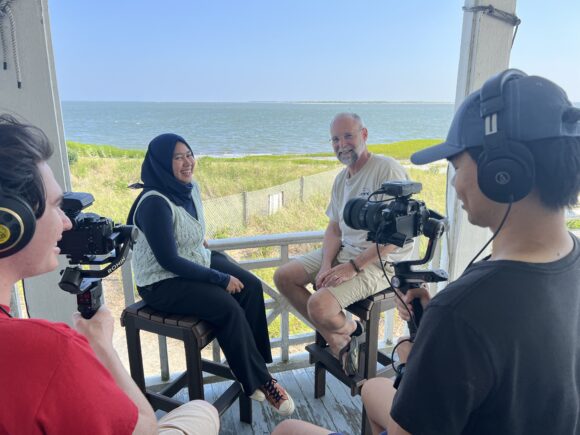
Shaniya Utamidata. Photo credit: Dena Seidel.
Shaniya Utamidata, a master’s degree student in Ecology and Evolution, was recently awarded a Planet Forward correspondent position from George Washington University because of her work in the storytelling lab. Utamidata came to Rutgers in part to study science storytelling with Dena Seidel and began investigating hours of video that featured scientists at the Rutgers University Marine Field Station (RUMFS). In the process, Utamidata imagined her own video storytelling for her master’s degree thesis that explores how methods used to study New Jersey’s Great Bay Mullica River Estuary might be applied to protect ecosystems in her home country of Indonesia. Utamidata has since been leading her own video shoots at RUMFS, capturing her exploration and conversations with scientists. She intends to measure how audiences learn from her science video story as part of her graduate research. “The lab has provided me with so many opportunities and so much support to embed science storytelling in my ecology and evolution research and thesis,” Utamidata said. “I am learning skills here that I will use for the rest of my life,” Utamidata said.

Or Doni. Photo credit: Dena Seidel.
Or Doni was an SAS cell biology major when he first came to the storytelling lab in 2022 and began co-directing the short science story, Biting Back: The Lifesaving Potential of Catnip. “I took on this science video project as my independent research to push myself to be a better communicator and it was one of the most transformative experiences of my undergraduate career,” Doni said, who starts his next chapter as a student at the Rutgers RWJ Medical School this fall. “To best serve their patients, doctors need strong, sophisticated communication skills. We live in a period of diminished public trust in science and medicine, and the onus is on doctors to be a bridge between science and the broader public,” said Doni, who won a Rutgers New Brunswick Chancellor’s Student Leadership award in 2024.

Emily Schneider. Photo credit: Dena Seidel.
Emily Schneider joined the storytelling lab in 2023 and spent a year co-directing the short science-in-action video, Biting Back: The Lifesaving Potential of Catnip, with Or Doni. This summer, Schneider was a guest speaker for the Governor’s School of Engineering and Technology program and shared how her work in the Storytelling Lab gave her skills that helped prepare her for her current job. “Making Biting Back required that I interview all members of an interdisciplinary science team to understand and communicate their complex scientific process. This scientific overview helped prepare me for my current position as a supply improvement engineer,” said Schneider, who recently graduated from the Rutgers School of Engineering and is a 2025 Rutgers New Brunswick Chancellor’s Student Leadership award winner.
Through the Storytelling Lab, Schneider and Doni attended conferences and film festivals, presenting Biting Back at Syracuse University, SUNY ESF, George Washington University and the Garden State Film Festival.
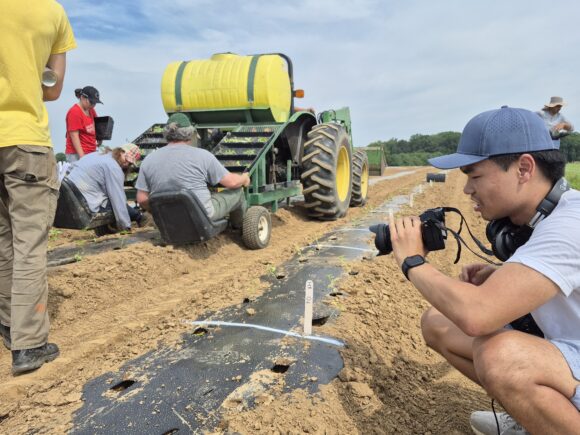
Evan Leong. Photo credit: Ava Medberry.
Evan Leong joined the science storytelling lab in the spring of 2025 and has since become a member of the USDA-funded basil plant breeding team, directing a series of video stories about the team’s research. This summer, he’s also recording and editing a short video story about oyster ecosystem benefits for a New Jersey Sea Grant project. Leong, who just graduated with a master’s degree from the School of Communication and Information, says his work in the lab gave him the experience he needed to secure a full-time job. “I came into the lab with no science training, but I’ve learned so much working here. The opportunity to direct science video stories with real world scientists provided me with the professional experience and confidence I needed to begin my new job as the marketing and communications director for the non-profit, Clean Ocean Action,” Leong said.

Colby Koutrakos. Photo credit: Evan Leong.
Colby Koutrakos, a SEBS junior studying ecology, began his independent research in the storytelling lab when he was just a first-year student. With no prior experience in video storytelling, he immersed himself in hours of ocean exploration footage and, in time, became a co-editor of the Mysteries of 9° North feature science-in-action storytelling project. Koutrakos also served as a mentor for the lab’s USDA FAME (Food, Agriculture and Marine Ecosystems) STEM learning through video storytelling afterschool program. In this current school year, he will serve as the editor for Jim Simon’s USDA basil research web series. “My experience working in the storytelling lab has been an incredible journey. Working directly with scientists, I now have a strong sense of responsibility to communicate their work and be the best storyteller I can be,” Koutrakos said.

Nicole Nikolova. Photo credit: Sean Feuer.
Nicole Nikolova joined the storytelling lab as a SEBS senior in physical oceanography. Her passion for exploring and shaping the lab’s science-in-action footage of scientists investigating life among deep-sea volcanoes was the subject of her independent research. She then presented her work at the Planet Forward Environmental Storytelling summit in April 2025. Nikolova’s demonstrated skill led to her summer job as a co-editor of the Mysteries of 9° North feature science-in-action project. “The lab gave me the experience I was always looking for and was grateful to find, helping me become a better science communicator and stronger researcher while discovering the potential of science storytelling,” Nikolova said. She begins this semester as a master’s student working with scientists in the Department of Marine and Coastal Sciences.
The Rutgers Immersive Learning through Science Storytelling Lab was created by a team of SEBS scientists, researchers and storytellers who have worked together since 2008 to successfully and impactfully communicate Rutgers science to the broader public through high quality science-in-action storytelling projects. Plant scientist Jim Simon and oceanographer Oscar Schofield have been working together advocating for new and effective ways for Rutgers research to be shared with the public.
“It is critically important that the public understand the value of science and its benefit to their lives. Scientists often don’t have the time or skill to communicate our work, but we can include storytelling as a research methodology for students interested in learning and sharing our science,” said Simon, one of the lab’s founders.

At the Garden State Film Festival.
The lab’s pedagogy is based on a science-in-action storytelling model developed by Dena Seidel, who has been directing and overseeing high impact science video storytelling projects at Rutgers, while involving students in the creative process, since 2008. Seidel currently supervises all the projects in the lab. “Our lab provides a welcoming space for students to creatively engage with science, develop trusting partnerships with scientists and feel empowered and respected to communicate the process of science in story form,” Seidel said.
Other key lab members include Xenia Morin who organizes science-in-action video screenings with community stakeholders, co-creates STEM learning through storytelling curriculum for the lab’s afterschool program and helps measure the STEM learning for participating students and audiences in collaboration with extension 4-H Agent II Marissa Staffen.
The Immersive Learning through Science Storytelling Lab is generously supported by Rutgers alumni Penny and Don Pray. “We support the Storytelling Lab because it is built upon an effective model with demonstrated success that is a win, win, win, win, win for everyone – scientists, students, the university, the public (including alumni) and the agencies that fund Rutgers research.” said Penny Pray. “We hope the storytelling lab’s successes will attract more support to leverage and share the important research going on at Rutgers – all for the greater good.”
Additional scientists who have been collaborating with students in the Immersive Learning through Science Storytelling Lab include Daphne Munroe, Ximing Guo, Andy Wyenandt, Rong Di, Thomas Grothues, Mark Robson, Ken Able, Dave Bushek, Mike Acquafredda, Janine Barr, Qing-Li Wu and Alvaro Toledo, plus more than a dozen graduate students.