
Imagine walking into a Rutgers health care center with a high fever and finding the place nearly deserted. Most of the nurses and doctors are sick, dead or too afraid to show up. For the remaining few, there are no gloves, soap or disinfectant. Jim Sim…
Archives for 2014
Past Climate Change Was Caused by the Ocean, Not Just the Atmosphere
Most of the concerns about climate change have focused on the amount of greenhouse gases that have been released into the atmosphere. But in a new study published in Science, a group of Rutgers researchers have found that circulation of the ocean plays an equally important role in regulating the earth’s climate…”We argue that it was the establishment of the modern deep ocean circulation – the ocean conveyor – about 2.7 million years ago, and not a major change in carbon dioxide concentration in the atmosphere that triggered an expansion of the ice sheets in the northern hemisphere,” says Stella Woodard, lead author and a post-doctoral researcher in the Department of Marine and Coastal Sciences.
RCE Collaborates with Hillsborough Township and Watershed Association to Win $175K DEP Grant
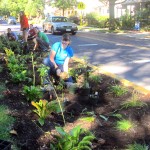
Rutgers Cooperative Extension (RCE) continues to expand its efforts in urban extension by securing funding to work directly with municipalities and their residents to address important issues affecting New Jersey’s towns. In one such effort, Rutgers Cooperative Extension of Somerset County has partnered with Hillsborough Township and Stony Brook-Millstone Watershed Association (SBMWA) to obtain a […]
Jersey’s trees still vulnerable two years after Hurricane Sandy
Two years ago this week, Hurricane Sandy ravaged New Jersey with a force not experienced here in a century, and the devastation it caused to coastal areas was the subject of local and national news for weeks and months after. “It was some of the worst storm surge flooding we’ve ever seen,” confirmed arborist Chris Padot, owner of Bridgewater-based Green Tree Surgeons. “But while coastal towns received much of the media attention,the extremely high wind gusts experienced in interior sections of the state wreaked incredible havoc on our area’s trees and created what seemed like a third world country here for a few weeks…” “Our trees have been taking a pounding for the past three years and there’s probably years’ worth of tree work still out there,” said Nicholas Polanin, agriculture and resource management agent with Rutgers Cooperative Extension in Bridgewater.
Arctic Sea Ice Volume 2014: Decline Leads to Colder Winters in Europe and Asia
A new study found a link between declining Arctic sea ice and the colder winters experienced in Europe and Asia near the Northern Hemisphere. Researchers from Atmosphere and Ocean Research Institute at the University of Tokyo performed 200 computer sim…
Our climate change is related to deep ocean currents and glaciations
The mapping of currents deep in the oceans has been a protracted study. A combination of deep ocean sediment core samples and NASA imaging now reveal that climate change is affected at least as much by the sea as by the air temperature. Rutgers Univers…
NJ more vulnerable to storms, flooding after Sandy
New Jersey’s vulnerability to powerful storms and coastal flooding is rising, and it will take at least 10 years to become more resilient, experts say. In Superstorm Sandy’s wake, officials last year sought innovative proposals on how to increase resilience in communities and along susceptible shorelines…Anthony J. Broccoli, a professor and co-director of the Rutgers Climate Institute, said “the risk of flooding from coastal storms is going to be changing dramatically over the course of the rest of this century and the risks will be increasing. That’s not because the storms (have) changed. It’s because the sea level is rising.”
Rutgers Hosts 7th Annual Pioneers in Endocrinology Workshop

“Hormones and Cancer” was the theme of the 7th Annual Pioneers in Endocrinology Workshop held last month at the Busch Campus Center. This annual daylong workshop was sponsored by the Rutgers Endocrine Program; Department of Animal Sciences at the Rutgers School of Environmental and Biological Sciences (SEBS); Rutgers NJAES Cooperative Extension; and Rutgers-RWJMS Division of […]
Study provides deeper understanding of climate change
Most of the concerns about climate change have focused on the amount of greenhouse gases that have been released into the atmosphere. But in a new study published in Science, a group of Rutgers researchers have found that circulation of the ocean plays an equally important role in regulating the earth’s climate…”We argue that it was the establishment of the modern deep ocean circulation – the ocean conveyor – about 2.7 million years ago, and not a major change in carbon dioxide concentration in the atmosphere that triggered an expansion of the ice sheets in the northern hemisphere,” says Stella Woodard, lead author and a post-doctoral researcher in the Department of Marine and Coastal Sciences.
Worldwide Surge in ‘Great’ Earthquakes Seen in Past 10 Years
The annual number of “great” earthquakes nearly tripled over the last decade, providing a reminder to Americans that unruptured faults like those in the northwest United States might be due for a Big One. Between 2004 and 2014, 18 earthquakes with magnitudes of 8.0 or more rattled subduction zones around the globe. That’s an increase of 265 percent over the average rate of the previous century, which saw 71 great quakes, according to a report to the annual meeting of the Geological Society of America this week in Vancouver, British Columbia…One of the researchers scoping out Cascadia’s history of ancient earthquakes is Benjamin Horton, a professor in the department of marine and coastal science at Rutgers University.