
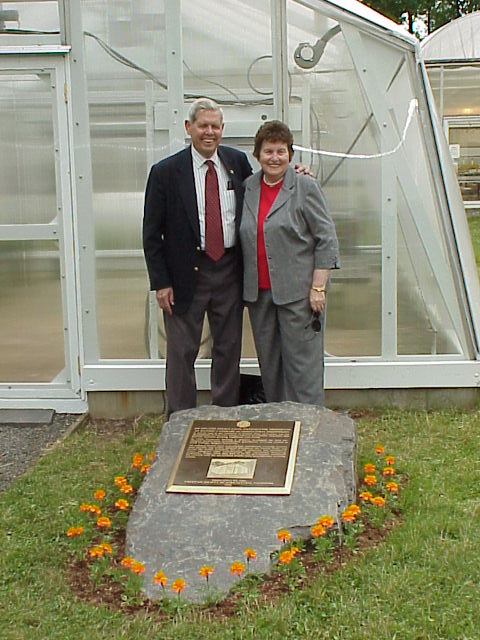
William Roberts and wife Dottie at the dedication of the first air-inflated, double-polyethylene greenhouse on the Cook Campus as a historical national landmark.
Sometimes innovation strikes at the most unlikely of times and in the most unlikely of places. While researchers can labor for months at their research facilities, a breakthrough may come while they’re tinkering at home in their garage or basement. Such was the case for Rutgers Cooperative Extension specialist William Roberts when he used an aquarium air pump to separate two layers of plastic film in a model greenhouse he was building in his basement on Christmas Day in 1964. As innocuous as it may seem, what Roberts did was actually an innovation that would one day, once developed for commercial application, revolutionize the use of greenhouses worldwide and be a boon to the agricultural industry.
Greenhouses, once regarded as a luxury for the rich, have been in use for centuries. The traditional glass structures allowed for a controlled environment to protect plants from cold or heat, and for the cultivation of exotic plants. It wasn’t until the 1960s, when polyethylene film became available in wide sheets ideal for industrial applications, that the construction of greenhouses became economical, leading to widespread agricultural use.
In the early 1960s, as an extension agricultural engineer, Roberts was working with some growers who were using low-cost polyethylene film on simple wooden frames to construct greenhouses used primarily for spring transplant production and bedding plants. One concern was the tendency for a roof made of a single layer of polyethylene to collect condensation that dripped on the small seedlings. To alleviate this problem, a second layer of film was added by fastening it to the underside of the frame, creating an airspace and keeping the inner layer warmer. This proved cumbersome, so the next development was to install the first layer over the frame and fasten it to the rafters with 2′ x 2′ spacers, followed by a second layer, which were then fastened down with a 1′ x 2′ beam. This was an improvement but still required two fastening steps for every rafter.
While this double-layer polyethylene greenhouse showed improved energy efficiency, on windy days the sheets of plastic were prone to flapping in the wind and would only last one growing season before having to be replaced. The new design of applying the second layer made the task slightly less laborious but was still a tedious process, which needed to be repeated annually. This cost growers time and money and limited the use of polyethylene greenhouses.
Roberts recalls his breakthrough. “Everyone needs at least one good idea in their career and mine came in 1964. On Christmas morning when I was supposed to be doing something else I was in the basement building a model greenhouse. We had been installing two layers of plastic film on greenhouse structures to reduce the energy consumption by 35% and it was a tedious and labor consuming job; plus it was not very effective. After I had built my model and installed two layers of film on it, I took a small air pump used in fish tanks and rigged it so that air could be blown between the two layers of film. And as I saw it blowing up, I said, ‘Thank you Lord, this is the way to overcome many problems and reduce the tedious work of double glazing’. The outer layer inflated outward and the inner layer was forced down over the rafter supports creating an air space and giving rigidity to the two layers so that in the normal wind situation the plastic would not flap and move in the wind like a sheet hanging on the clothes line. It all clicked in my head as the way to go.”
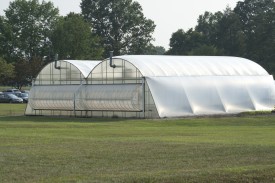
The AIDPG system can be applied to any size greenhouse.
This concept was successfully applied to a greenhouse on the Cook Campus. It was essentially a wooden frame structure designed for the width of polyethylene sheeting available at the time. A small commercial air blower was used in place of the fish tank pump. Researchers noted that not only was there a significant reduction in the required construction materials and labor, but the tension in the film from the slight air pressure reduced the film flexing and flapping in the wind. This, in turn, reduced the likelihood of tearing, thereby increasing structural reliability and extending film life. This very first structure using this air-inflated, double-layer polyethylene design was located on Ag Extension Way, behind the Extension Conference Center off of College Farm Road on the Cook Campus. That greenhouse is now a national landmark but more on that later.
This concept was next applied to a portion of a large commercial greenhouse in Allentown NJ at Kube-Pak, Inc., which was then owned by Fred and Bernie Swanekamp. Roberts’ cautious approach was overruled by Fred’s unbridled enthusiasm. “I asked Fred if he wanted to try it on one bay and he said that he wanted to do one half the greenhouse, which was a greenhouse of six acres. I told him I wanted to sleep at night but he was so excited about the idea that he proceeded to cover one half of the structure with the air inflated system,” Roberts remembers.
Roberts’ fears were quickly put to the test. “I distinctly remember in the spring of that year on a very windy Saturday staying away from the telephone because we were having hurricane force winds. I didn’t want to hear about the damage to the greenhouse. I heard on the radio that the roof blew off the Polestra, a large basketball arena in Philadelphia and I still received no call from Fred. Finally when I could stand it no longer I called him on Monday morning. He said ‘It was no problem’. The original method of covering on one half of the roof blew off during the storm but the new section was not damaged, so he covered the remaining 500 feet of the entire 1,000-foot long greenhouse with the air inflation system. The Kube-Pak greenhouses today are covered in the same system developed almost 50 years ago.”
Roberts is mindful of the fortuitous circumstances of the wind event. “This replicated a very large research project with no need for a sponsored grant or an expensive New Jersey Agricultural Experiment Station project.”
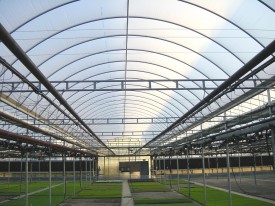
Kube-Pak in Monmouth County, the first commercial greenhouse to test the AIDPG system, currently uses it on 803,000 square feet (18 acres) of gutter-connected double-poly greenhouses.
The commercial application of the air-inflated, double-layer polyethylene (AIDLPG), also referred to as “double plastic” greenhouses, spread like wildfire. Several companies then developed steel and aluminum frame structures for multi-span and single-span greenhouses, which could effectively use the double plastic system. Roberts also designed wooden greenhouse frames of several sizes to match available polyethylene film widths, as well as a pipe frame structure and pipe bender to assist in the hand-bending of the hoops. He developed the engineering plans and drawings for these easy-to-construct greenhouses.
These plans were made available through a USDA-supported service consisting of contributions by land-grant universities and their extension personnel, thereby providing construction blueprints for growers (see a sample here). The early popularity of these designs and their rapid commercial acceptance were due primarily to their low cost relative to conventional greenhouses glazed with glass or fiberglass. The insulation properties of the inflated air space reduced heat requirements by over a third, further reducing costs to growers.
The work on the AIDLPG that Roberts initiated at Rutgers in 1965, along with the contributions of the commercial growers who took the early risks, helped this development spread rapidly and extensively into commercial agriculture. The innovation was quickly adopted for commercial use and became the basis for a rapid expansion in plastic greenhouse acreage. Today, about 65 percent of commercial greenhouses in the U.S. and throughout the world that use double-glazing utilize this system.
The AIDLPG so revolutionized the industry that in 2004, the American Society for Agricultural and Biological Engineering (ASABE), dedicated the structure of the first air-inflated, double-layer polyethylene greenhouse as an ASABE Historic Landmark. Prior to this dedication, only 42 such landmarks had been dedicated in the U.S. since 1926.
How does this historical national honor rank with Roberts? “It was number 43 on the list, along with the development of the first plow and the cotton gin. Very humbling.”
Roberts and colleagues were not ones to sit on their laurels. Stemming from that development, and under the leadership of now Professor Emeritus David Mears, Roberts worked on further advances in the technology. The development of the AIDLPG also set in motion other advances like solar heating systems for greenhouses, movable thermal insulation screens and in-floor, root zone heating systems.
Today, Arend-Jan Both, associate extension specialist in controlled-environment engineering, is Roberts’ successor. Both points out some further advantages of the AIDLPG design. “While the second layer reduces light transmission, sunlight passing through two layers of greenhouse film is more diffused. Research has shown that this diffused light can reduce heat stress on sunny days, and it makes the light distribution inside the greenhouse more uniform with deeper penetration into the plant canopy.” Both notes the challenge of this system remains that “as a result of breakdown due to UV degradation, the film needs to be replaced after three to four years.”
Greenhouse restoration for landmark dedication
Joseph Florentine, director of Greenhouse Operations at Rutgers NJAES, discloses the global significance of Roberts’ innovation. “I think the most important aspect of Bill’s invention is that the inflated plastic greenhouse is used extensively in third world countries to extend their growing seasons, thereby increasing food security. Bill’s invention not only aids commercial growers with low cost greenhouses, it is also helping undernourished people in this world to provide their own food. His idea literally revolutionized world agriculture by making food grow, inexpensively, where and when it could not grow before.”
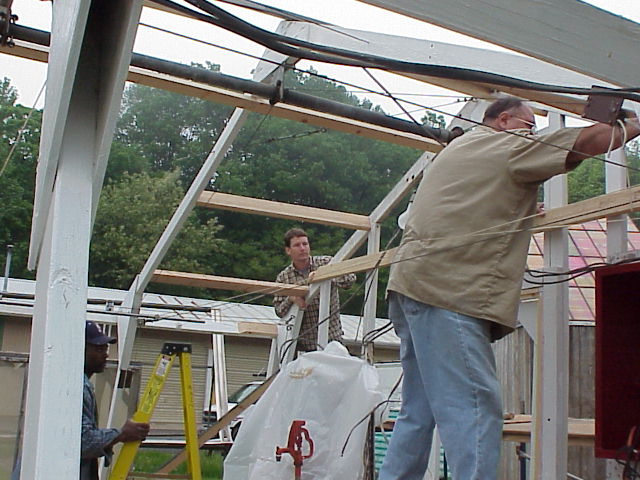
While much of the research at Rutgers leading to advances in greenhouse engineering has been conducted in various campus greenhouses, the original AIDLPG structure has also been in continuous use for a variety of research studies. Before the landmark dedication in June 2004, the structure, which was built in 1962, was showing some wear. Greenhouse Operations and Management staff and two carpenters from University Facilities worked to restore the greenhouse, replacing rotted wood, repainting and recovering the structure. Greenhouse Operations has made the commitment to maintain this landmark, despite no dedicated funds to do so.
Besides commercial growers, consumers have reaped the benefits of Roberts’ application. Thanks to these double-plastic structures, the flowers we buy in full bloom, the flats of vegetable and herb transplants for springtime planting and local vegetables grown in plastic covered greenhouses to extend the early or late seasons, can be produced locally and economically. The cultivation of tomatoes in these greenhouses can occur year-round, as can other high-value crops.
So, the next time you’re poring over the flats of vegetable transplants in a garden center greenhouse, look around to see if the structure is an AIDLPG. If so, you can say thanks to Rutgers Cooperative Extension ag engineer Bill Roberts and his Christmas Day tinkering in 1964.