
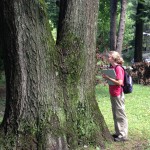
“The mosses were just labelled Moss 1, Moss 2, that it just struck me how much mosses are overlooked,” says Eliana Geretz, ecology, evolution and natural resources major. At the time, she was helping conduct research in Hutcheson Memorial Forest in nearby Somerset County. One of the last uncut forests in the Mid-Atlantic States, the […]
Search Results for: "Myla Aronson"
30 Species Discovered … in L.A.? Cities Buzz With Life
Urban biodiversity isn’t just limited to buzzing insects. Last year, a study found that 54 cities are home to 20 percent of the world’s bird species. In the city of Lyon, scientists found nearly a third of all the bee species native to France. It turns out that cities are a good place for some animals to live- and how humans decide to manage their cities can make those habitats better or worse for the local fauna… Anyone who has ever walked through a flock of pigeons knows birds do pretty well in cities, too. That isn’t to say that birds prefer cities- urban areas only retain about 8 percent of the bird species that otherwise would have lived in the area, according to a study led by Myla Aronson of Rutgers University… But cities are still filled with a rich variety of birds. Aronson and her team looked at 54 cities around the world and found that 20 percent of known bird species can be found flying in urban centers…”From city to city, across the world, maintaining natural habitat within a city is important for biodiversity,” Aronson told NBC News.
Rutgers Research on Nature in Cities Featured in National Magazine

Myla Aronson (GSNB ‘07 Ph.D.), research scientist in the Department of Ecology, Evolution, and Natural Resources, has conducted far-reaching research that shows cities are not concrete jungles but instead harbor a variety of native birds and plants. Her work supports the argument that planning greenspaces in cities with biodiversity in mind benefits both people and nature. […]
Urban Wildlife Bounty
I’m strolling the grounds of the New York Botanical Garden, a quiet green space in the noisy heart of the Bronx. The sun is hot, but once I leave the neat, conventional garden beds and enter the Thain Family Forest, the air is cool under old-growth oak and hickory trees. And when the roar of a JFK-bound jet dies away, I can hear catbirds, white-eyed vireos and a kingbird running through their vocal repertoires… I’m walking the Spicebush Trail with Myla Aronson, a Rutgers University scientist who is the lead researcher on a groundbreaking study of biodiversity in cities across the globe—a study that refutes what she calls the myth of biotic homogenization. “Everyone assumes that because of globalization, cities are all the same in terms of the plants and animals you find there- mostly rats and pigeons,” Aronson says as we stroll.
Faculty and Staff Accomplishments
We congratulate these SEBS and NJAES faculty and staff on their accomplishments, appointments and awards below. For university-wide announcements, please visit the Rutgers Faculty and Staff Newsletter. 2026 Troy Roepke, Professor and Associate Dean of Faculty Development and Workplace Culture, School of Environmental and Biological Sciences, is among the inaugural cohort of 2026-2027 Executive Faculty […]
Migrating to The City: How researchers are beginning to think differently about urban biodiversity
High above southwest Pennsylvania, it’s not unusual to look up and spot a bald eagle flying thousands of feet in the sky, on the hunt for prey. What’s especially surprising is that its nest isn’t in a secluded forest; it’s in the industrial heart of Pittsburgh, in a neighborhood called Hays…”Cities have lost a lot of biodiversity, but they support a lot more than we normally expect them to,” agrees Myla Aronson, a visiting professor of ecology at Rutgers University in New Jersey. She and several other researchers around the world recently published a comprehensive study that found while urbanization does decrease the abundance of plants and animals, the mixture of species continues to resemble the mix of the region.
City Birds and Plants in Decline
Most bird and plant species in cities are native to those areas, but their numbers are rapidly decreasing around the world. Myla Aronson at Rutgers University in New Brunswick, New Jersey, and her colleagues compiled and analysed data for birds in 54 c…
Green spaces in cities could restore species lost to urbanisation
A new study analysing the impact of urbanisation on biodiversity has found that protecting green spaces and restoring plant species in cities could allow developed areas to retain their flora and fauna. The work, published in the journal Proceedings of the Royal Society B, gathered lists of plants in 110 cities and lists of birds found in 54 cities from around the world. “We were interested in plants and birds that were found in all parts of the city – from buildings, roads, vacant lots, brownfields, managed green spaces, and natural green spaces – to understand how cities support biodiversity as a whole”, Dr Myla Aronson, study co-author and research scientist from Rutgers, the State University of New Jersey, told BBC News.
Study shows urbanisation’s impact on biodiversity
A dataset, described as the largest of it kind to date, has assessed the impact of urbanisation on biodiversity levels around the globe. It found that cities supported far fewer species of birds and plants compared with similar areas of undeveloped land. However, it showed the vast majority of flora and fauna in a city reflected an area’s “unique biotic heritage”…”While we show that urbanisation has caused cities to lose large numbers of plants and animals, the good news is that cities still retain endemic native species, which opens the door for new policies on regional and global biodiversity conservation,” said co-author Myla Aronson, a research scientist from Rutgers University, in the US state of New Jersey. “In particular, the study highlights the value of green spaces in cities, which have become important refuges for native species and migrating wildlife.”