
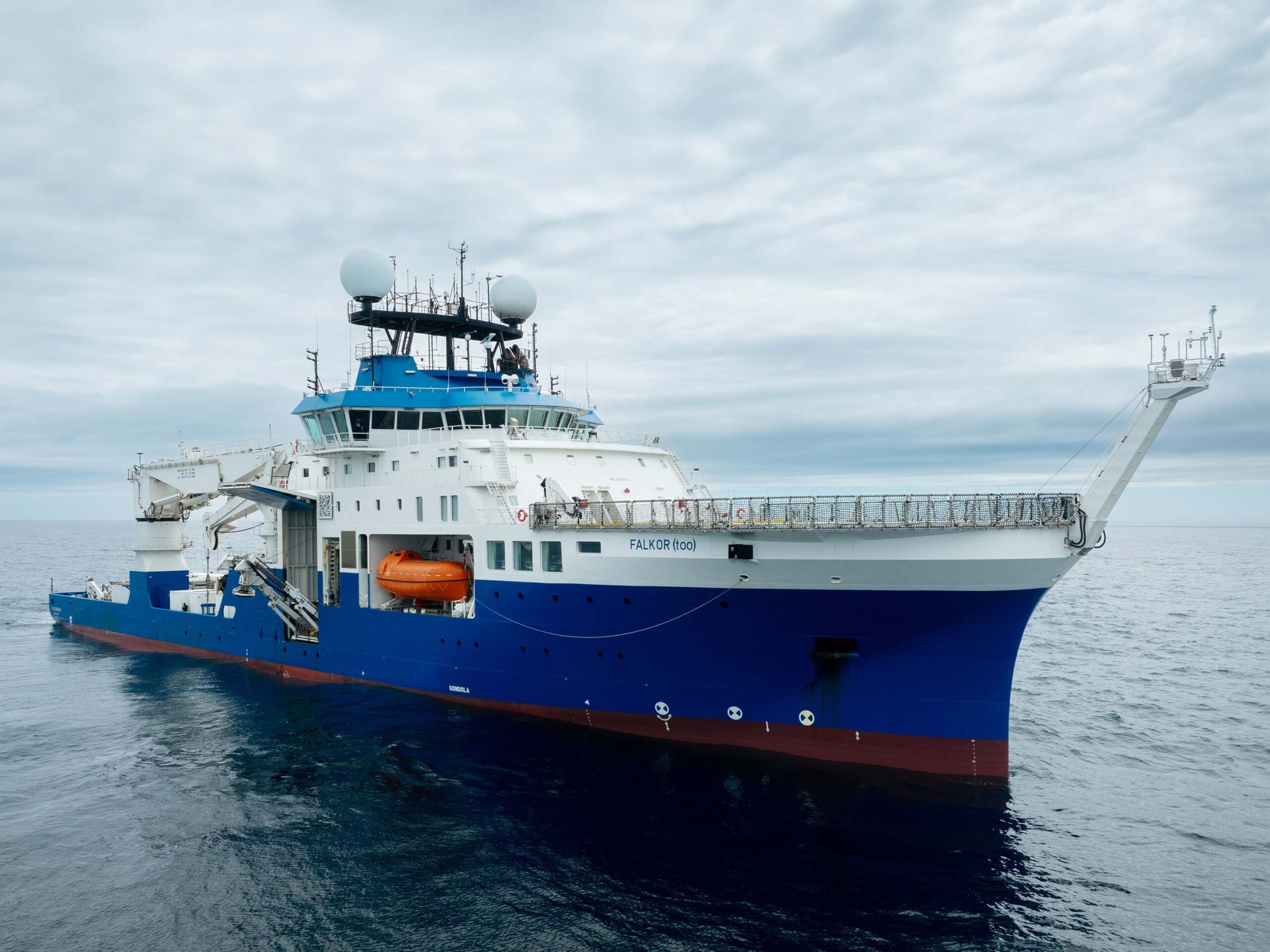
The R/V Falkor (too) is a state-of-the-art research vessel operated by the Schmidt Ocean Institute. Photo: Courtesy of the Schmidt Ocean Institute
Long before leaving port, Rutgers oceanographers Joe Gradone and Corday Selden are focused on packing crates of sensors, autonomous underwater gliders and instruments—some “as delicate as a potato chip”—for a mission to probe one of the ocean’s most elusive processes. In August 2026, the pair will lead a 28-day expedition aboard the state-of-the-art R/V Falkor (too), operated by the Schmidt Ocean Institute, to study salt fingering, a small-scale mixing phenomenon that may shape ecosystems and global climate.
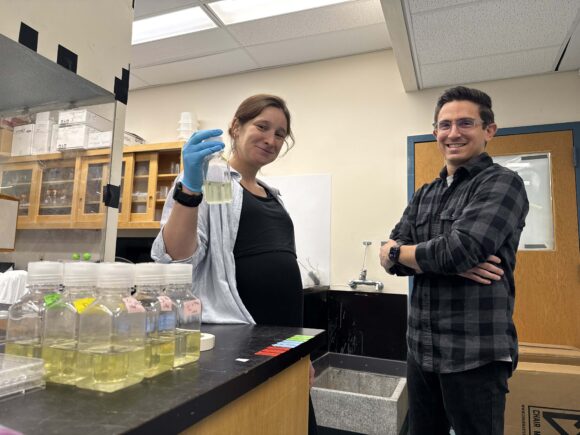
Corday Selden (left), an assistant professor, and Joe Gradone (right), an assistant research professor, are in the Department of Marine and Coastal Sciences in the Rutgers School of Environmental and Biological Sciences. Photo: Courtesy of Rutgers University
Gradone, an assistant research professor in the Department of Marine and Coastal Sciences (DMCS), studies the physics that stir the sea. Selden, an assistant professor and biological oceanographer, also in DMCS, investigates how that mixing affects marine life and chemistry. Together, they are bridging microscopic ocean processes with climate-scale consequences. Ocean mixing regulates everything from hurricane intensity to nutrient supply, influencing phytoplankton growth and the biological carbon pump—the mechanism that removes carbon dioxide from the atmosphere.
The mission, “Surveying Salt Fingering in the Caribbean,” will target the western equatorial North Atlantic, a hotspot for thermohaline staircases—layered waters where warm, salty water overlies cooler, fresher water, triggering vertical exchanges of heat, salt and nutrients. The team will deploy four autonomous gliders, a vertical microstructure profiler to measure turbulence, a CTD rosette to sample discrete water layers and an Imaging FlowCytobot to photograph individual phytoplankton cells.
Researchers will investigate whether salt fingering has intensified as ocean salinity patterns shift and whether the process delivers enough nitrogen to stimulate phytoplankton growth and carbon export. Supported at no cost by the Schmidt Ocean Institute through a highly competitive selection process, the expedition brings together 24 scientists, including students from Rutgers and partner institutions in Barbados, Brazil and Sweden.
As the R/V Falkor (too) departs Trinidad for the equatorial North Atlantic, it will carry more than advanced instruments. It represents a rare opportunity for early-career Rutgers scientists to lead an international effort aimed at understanding how fine-scale ocean mixing can ripple through marine ecosystems and the global climate system.
Read the full article, which first appeared in Rutgers Today.