

Karyn Malinowski, triple Rutgers graduate and professor of Animal Sciences, has retired after 47 years of service.
Karyn Malinowski, equine sciences extension specialist and professor, retired on June 30, after 47 years at the Rutgers School of Environmental and Biological Sciences. She is a triple alumna of Rutgers, earning a bachelor’s and master’s degree in animal sciences and a doctoral degree in zoology. At the time of her work towards her doctoral degree, the Endocrinology and Animal Biosciences Program did not even exist.
She joined the faculty in 1978 as the first female Equine Extension Specialist in the United States. Wearing many hats over the years, she served as a Professor in the Department of Animal Sciences, the Associate Director of the New Jersey Agricultural Experiment Station, and Founding Director of the Equine Science Center. From 2002 to 2008, she was the also the Director of Rutgers Cooperative Extension.
Malinowski’s research and extension programs concentrated on improving the well-being and quality of life of the equine athlete while ensuring the vitality and viability of the equine industry, both statewide and nationally.
“Dr. Karyn Malinowski has been a pioneering force in Equine Extension—not only within the state of New Jersey, but across the region and the country. Her contributions have elevated the field, opened doors for women in Extension, and strengthened the partnership between academia and the equine industry,” said Carey Williams, equine extension specialist and professor in the Department of Animal Sciences. “Her legacy is defined by excellence, innovation, and service, and the reach of her work is reflected in the many individuals and institutions she has influenced.”
Malinowski’s research on recombinant equine growth hormone provided cutting edge insights into the treatment of geriatric horses; and her research on the effects of aging have resulted in a large body of information on the care of the older equine athlete.
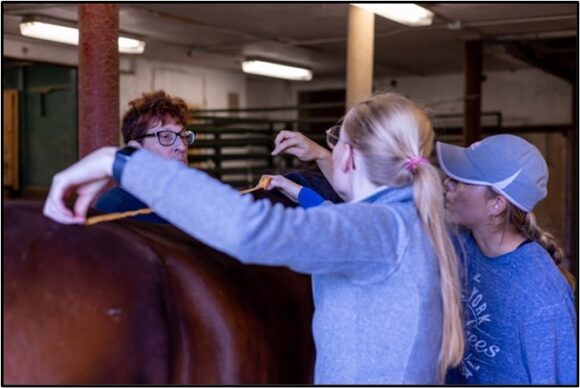
Karyn Malinowski working with students at the Ryders Lane Best Management Practices Demonstration Horse Farm at Rutgers.
Her love of teaching and training is evident by the numerous mentees that she has advised over the years. Mentoring countless undergraduate and graduate students and serving as the major professor to three postdoctoral associates, two doctoral and three master’s students, Malinowski’s legacy lives on in the work of the next generation of equine scientists.
Malinowski took on the mantle of building the equine science program at Rutgers, leading the industry effort that resulted in Cook College and the New Jersey Agricultural Experiment Station receiving $1.2 million for Strategic Initiatives in 1992 from the NJ state legislature. The equine science program received $300,000 per year, for multiple years, in no small part due to her advocacy for equine science, animal science, and the success and dependability of Rutgers’ research and extension activities.
“Dr. Malinowski has dedicated herself to better horse care through research and education. Her decades of tireless efforts to ensure the viability of the New Jersey equine industry has had a major impact on public policy in the state and nationally,” said Kenneth McKeever, professor of equine exercise physiology in the Department of Animal Sciences. “Her career is a model of excellence in all three parts of the land-grant mission: research, teaching, and outreach/service.”
Malinowski is also responsible for the Lord Nelson joining Rutgers, one of the first horses brought to campus to be used by the RUPD’s mounted patrol unit. Lord Nelson went on to become the horse used for the Rutgers Football Games, and then eventually “retired” from the university, to only be brought back as the mascot of the ever successful “Equine Science 4 KIDS!” program.
In her retirement, Malinowski plans to stay engaged with the equine industry, and after taking a well-deserved break no one would be surprised if she appeared for guest lectures or consulting, always willing to share her lifetime of experience and knowledge.