
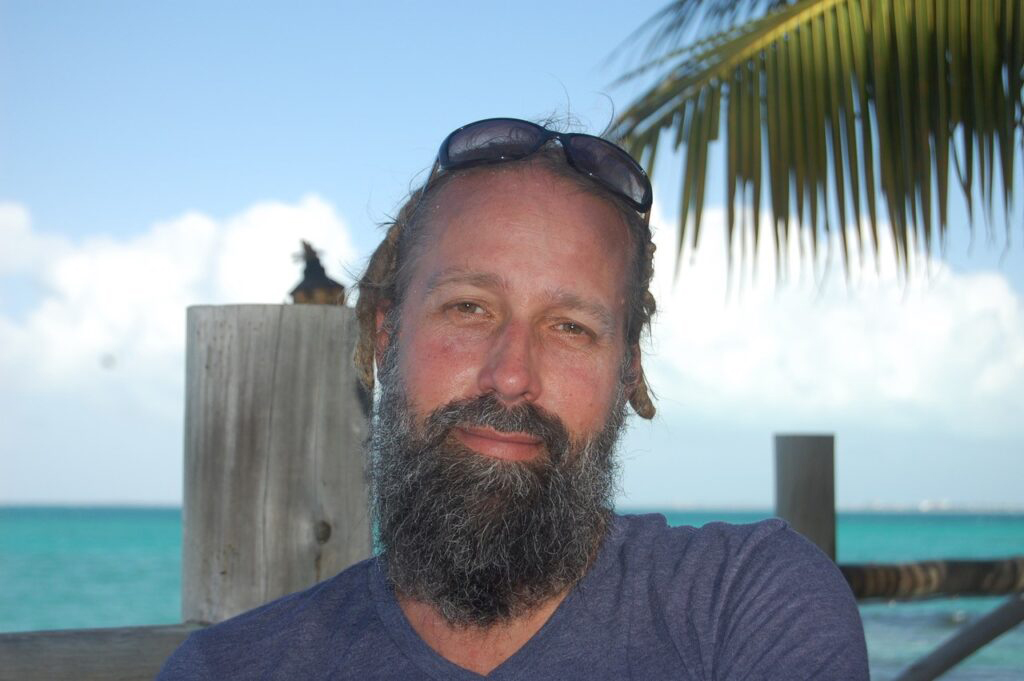
Prof. Kay Bidle is an ARIS inaugural 2025 Research Fellow.
Kay Bidle, professor in the Department of Marine and Coastal Sciences (DMCS), has been selected for the Center for Advancing Research Impact in Society’s ARIS inaugural 2025 Research Fellowship. Created to support notable researchers who are equally invested in their research and its impacts, the ARIS Research Fellowship focuses on how researchers can increase their capacity to frame their research as a benefit to society–an idea the National Science Foundation (NSF) terms Broader Impacts.
“I am very excited for this opportunity to be an ARIS Fellow and share my own expertise and experiences in developing a Broader Impact identity over the years through collaborative efforts with my colleagues, both here at Rutgers and across the country,” Bidle commented.
Bidle is no stranger to collaboration. Over the course of his career at Rutgers University, he has worked with several academic partners and contributed several papers to the field of biological oceanography. In 2020, he and collaborators were awarded a highly competitive ~$3.5 million NSF Growing Convergent Research (GCR) grant to fully flesh out the different processes (e.g. physical, chemical, biological, mathematical) that occur when a specific marine virus, Coccolithovirus, infects a specific phytoplankton species, Emiliania huxleyi. From this work, they have expanded on our knowledge on how viruses like these can influence the carbon cycle, two subjects that seem separate at first glance.
While pursuing this research, he and his frequent collaborators, Kim Thamatrakoln, associate professor, DMCS, and Janice McDonnell, Rutgers 4-H STEM agent and lead member of ARIS, also co-developed a high-quality suite of educational films called Tools of Science. Tailored to meet the Next Generation Science Standards, these films follow Bidle and team as they pursue their GCR projects in the lab and on research cruises. By investing in communicating their science as they are actively researching, they have created eight educational videos directly connecting the newest Rutgers research to K-12 classrooms in the state and around the nation.
Bidle’s GCR research and Tools of Science impact work will be the context he brings to the ARIS Research Fellowship. It has “given a unique platform for us to think about how best to prioritize the multifaceted impacts of our research on society more broadly,” he says.
Bidle and the other Research Fellows will receive personalized guidance from ARIS leadership to expand their innovation and leadership in Broader Impacts initiatives at their institution. He joins four other colleagues (Dr. Melissa Libertus, University of Pittsburgh; Dr. Roger Narayan, North Carolina State University and University of North Carolina; Dr. Petronela Radu, University of Nebraska-Lincoln; and Dr. Rachel Thibodeau-Nielsen, University of Missouri) in this year-long cohort-based program.
“My peer colleagues in this ARIS cohort are also exemplars in integrating their research work with their diverse broader impact work,” Bidle added. “I am eager to interact with and learn from them as we all work to become leaders in this critical area of increasing research impacts on society at our respective institutions.”
The year-long fellowship will conclude with the five Research Fellows presenting their projects to the attendees at the 2026 ARIS Summit. They will also participate in ARIS programming throughout the year and share their experience and tools with their local and professional communities. “We are proud to partner with this amazing group of ARIS Research Fellows to enhance their leadership skills in research impact and our ability to support researchers and their institutions,” Dr. Susan Renoe, ARIS Executive Director, affirmed.
About ARIS: The Center for Advancing Research Impact in Society (ARIS), formerly the National Alliance for Broader Impacts, was founded in 2014 and is the largest societal impact community organization in the U.S. ARIS supports practitioners, researchers and communities in achieving positive societal impact. With more than 1,800 members worldwide, ARIS offers resources, certifications, and programs to build capacity, grow partnerships and enhance scholarship. Visit researchinsociety.org
Editor’s note: This article was written by Mitaali Taskar, a science communicator and research project assistant with Rutgers Department of Marine and Coastal Sciences, Rutgers School of Environmental and Biological Sciences.