
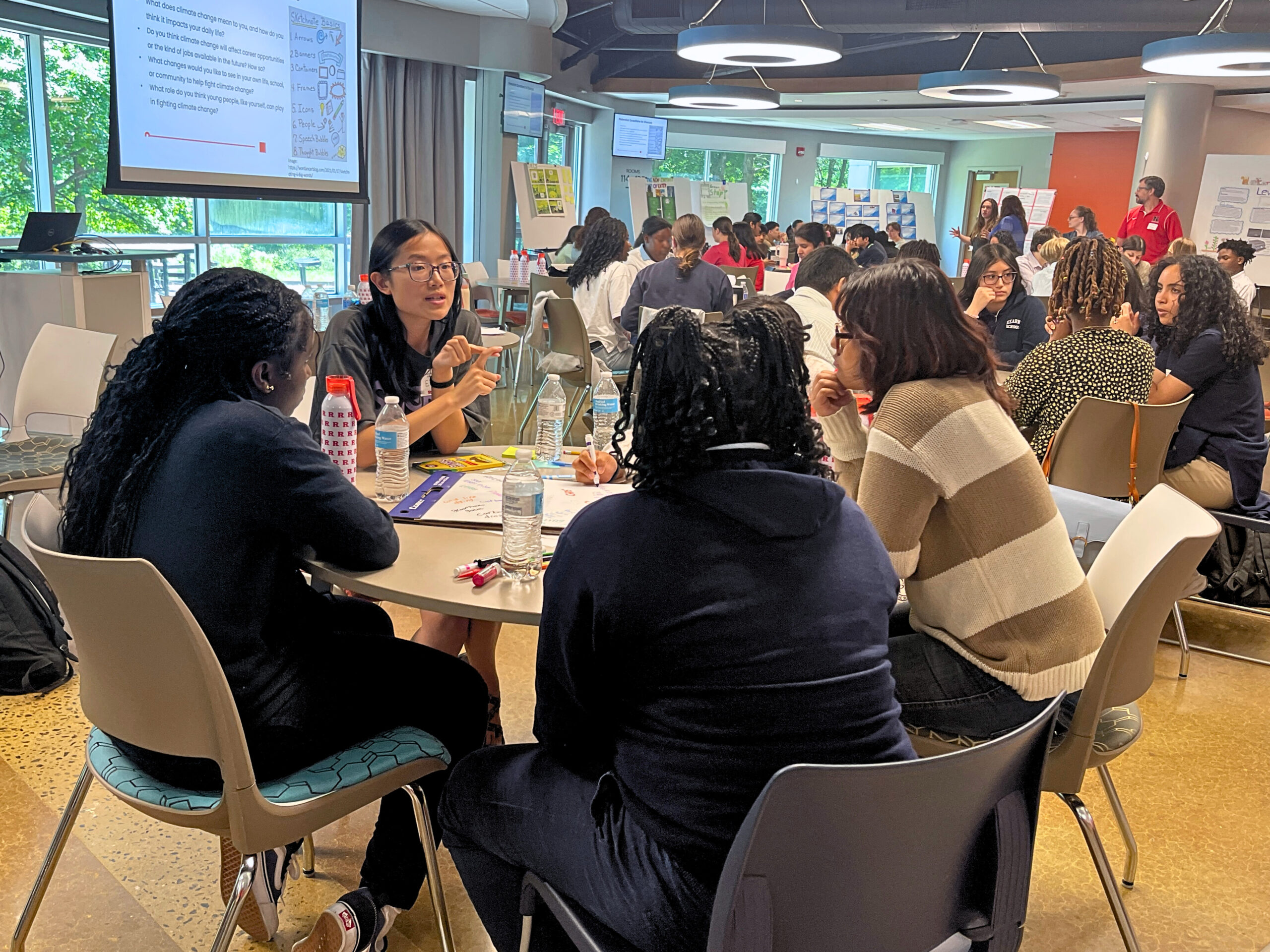
New Jersey youth were asking at the Climate Teen Summit on June 4, 2025, held at the Rutgers Lifelong Learning Center. Courtesy of DMCS.
Why is climate change talked about so much but yet so little? When will people start to take this issue seriously? What is being done to reduce the effect of climate change? What small things can we do every day to prevent the increase of climate change?
These are the questions New Jersey youth were asking at the Climate Teen Summit on June 4, 2025, held at the Rutgers Lifelong Learning Center. Students, grades 6-12 from across the state, presented community-focused climate solutions to Rutgers graduate students, faculty, staff, and, perhaps most importantly, to their peers.
The workshop was a collaboration among the New Jersey Climate Change Resource Center, Rutgers Center for Mathematics, Science, and Computer Education, Rutgers Center for Ocean Observing Leadership, Rutgers Climate and Energy Institute, Rutgers Cooperative Extension and Rutgers Science Explorer Program.
How did this start?
The impetus for this Summit was last year’s innovative Climate and Data Literacy Workshop, which brought together educators from throughout New Jersey to not only expand their climate change knowledge but also to connect with community partners and explore local climate solutions they could consider with their students. The teachers were introduced to Rutgers resources, including a suite of local data-visualization and mapping tools called NJ ADAPT.
Armed with new community contacts and Rutgers content to integrate into their curricula, the educators returned to their schools and together with their students implemented a plan over this past school year focusing on advancing climate change solutions in their communities with an eye toward sharing solutions at the Teen Summit.
 “We prepared by exploring different aspects of climate change — from rising sea levels to plastic pollution. Students selected topics they were passionate about and worked in teams to research, brainstorm solutions, and build creative presentations and models,” said Rosana Wright, a teacher at Jersey City’s Dr. Michael Conti Public School #5 whose students attended the summit.
It was at this summit that students from Kearny, New Brunswick, Neptune, and Jersey City met each other and discussed the similarities and differences between the climate solutions each city had devised for their unique community.
Youth Driven Solutions Lead the Way
Despite the distance and the fact that none of the students had interacted with the students from the other districts before, some of the proposed solutions were similar. This included green roofing to combat local urban heat island effects and rain gardens to refocus stormwater into the ground and prevent flooding.
Other students presented unique solutions designed for their locations, like artificial trees for pavemented areas or a “GreenStop” (an eco-friendly bus stop, supplied with accessible features, storm drains, and a green roof) for busy public transit routes.
“I feel my students took away a lot of information from the other groups regarding how climate change could be tackled in other communities,” Christina Tuozzolo, a science teacher at Neptune Middle School commented. “We are a shore-based community in Neptune and some of the other schools were city based, so my students were able to see how climate change was impacting a different type of community and other innovative ways to begin tackling the climate change problem.”
In Kearny, students integrated sustainability awareness events into already-existing local community events. Dubbed “Community Eco-Awareness Events”, these students worked with ESL/Bilingual families to learn about ways to upcycle, such as creating affordable reusable bags and drink coasters from old clothing and potting familiar herbs and vegetables for households.
 New Brunswick students focused on the urban heat island effect, a climate issue they were familiar with since their school is surrounded by warehouses and impervious pavement. Using temperature data gathered from an aggregate of trusted sources (including the Rutgers Climate Change Resource Center, the Office of the New Jersey State Climatologist, and state and federal offices), they proposed green roofs, rain gardens, and reflective roofing.
“It was so heartening to learn about how these students have taken what they know, what their teachers have taught them, and what their community has been telling them to create these ideas,” said Dr. Marjorie Kaplan, Senior Associate Director at the Rutgers Climate and Energy Institute. “We do this work because these students have so many ideas and so many insights on how the climate crisis is affecting their communities. We want to, not just listen, but support their action.”
What do the students hope for?
For these students, climate change is a reality, not an abstract issue for a future generation to solve. They see the health problems exacerbated by the changing climate and the effect on their daily routines. They ask questions like “What else can people do at home to help?”, “Can government help to change climate change?” and “How much time do we have to live if we don’t change our ways?”
When asked how climate change made them feel, many expressed worry. Worry for the severe and perceived irreversible damage. Worry for their future. Worry over the inaction they witness.
They also expressed motivation to do something. They feel responsible. They understand their roles at play.
“Their voices matter,” commented Wright. “They realized they can make a difference, even as 6th graders. The summit was just the beginning for them.”
As one student wrote, “[It] makes me feel like we need to take action. The longer it takes for a change to start, the worse it gets, so we need to step up.”
Editor’s note: This article was written by Mitaali Taskar, a science communicator and research project assistant with Rutgers Department of Marine and Coastal Sciences, Rutgers School of Environmental and Biological Sciences.