
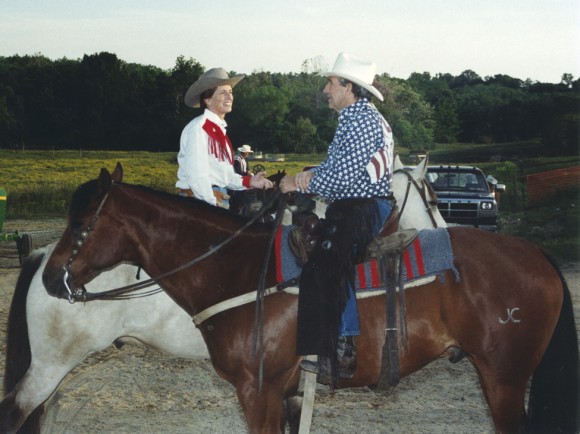
New Jersey Governor Christine Todd Whitman and Secretary of Agriculture Art Brown
Paging through the many personal photo albums that Art Brown’s staff and friends have compiled for him over the years, one is struck by his cheerful exuberance in the images. Clearly, Art Brown is a person who enjoyed his career as New Jersey’s longtime Secretary of Agriculture. And New Jersey enjoyed his valuable contributions during his decades-long tenure.
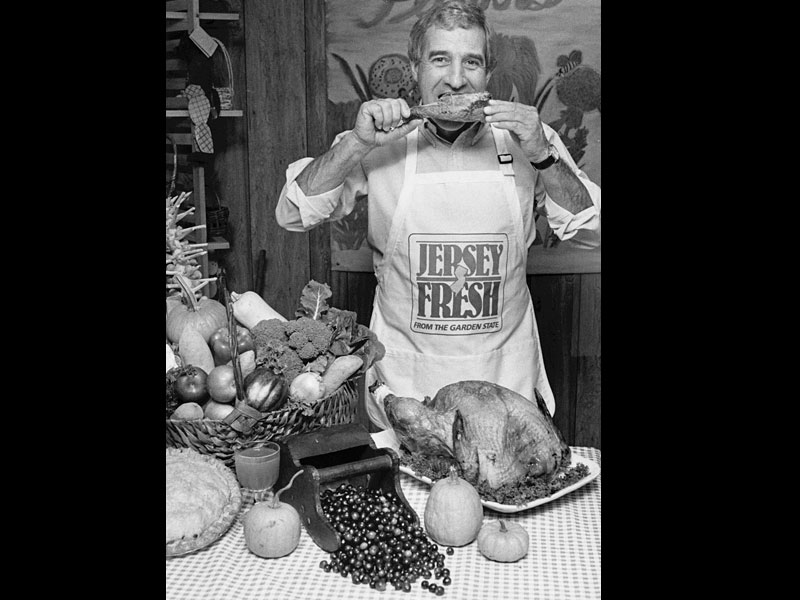
The leading architect of the popular “Jersey Fresh” marketing campaign that broke new ground by focusing on locally grown produce and became a model for such programs nationally, Art was tireless in promoting New Jersey agriculture in its various forms. He is shown tasting a spoonful of honey at a fair, eating Jersey corn or a leg of Jersey-bred turkey, posing with a prize-winning rabbit, sampling fresh oysters, picking pumpkins, sitting astride a cutting horse, making the rounds at the county fairs, shaking hands at the Horse Park of New Jersey, promoting Jersey Fresh products for school lunches, and on and on.
It almost seems as though where two or more farmers were gathered, Art was there. By his side, in many cases, was one of the eight New Jersey governors under whom Art served. They were Tom Kean, who appointed him in 1982; Jim Florio, starting in 1990; Christie Whitman, beginning in 1994; Donald DiFrancesco, who took office in 2001; three who held the office ceremonially in early 2002: John Farmer Jr., John O. Bennett and Dick Codey; and finally Jim McGreevey, inaugurated on January 15, 2002. “It didn’t matter whether they were Republican or Democrat, I got along with all of them,” he says.
Art retired from the Department of Agriculture in 2002. However, he continued his career by coming back to the faculty of Rutgers’ School of Environmental and Biological Sciences (it was called Cook College back then) to teach, consult and return to his roots as an Agricultural and Resource Management Agent with Rutgers Cooperative Extension.
He recalls that when he finally retired in 2008, “then-President McCormick sent me a letter, conferring emeritus status on me with 37 years’ experience. Of course, that included a 20-year leave of absence – I’m willing to bet the longest in the university’s history.”
NJ Secretary of Agriculture Art Brown Through the Years
Jersey Fresh was an important milestone in Art’s career, but only one of many. An article in The New York Times around the time of Art’s retirement enumerated other significant accomplishments:
“His second priority was farmland preservation,” the Times wrote. “The numbers tell the story: In 1953, farms covered 1.7 million acres of New Jersey; by 1997, that had fallen to 830,000, according to the latest Census.
“Today the state is in a close race with developers, permanently preserving about as much farmland as it loses each year – 10,000 acres – under a program developed by Mr. Brown that is considered the most aggressive in the nation.”
The Farmland Preservation program was able to succeed because farmers trusted Art, the newspaper went on to report. This was because he was an authentic farmer, but more important, he influenced with his personality and perseverance. As one farmer put it, “I’ve never seen a more positive attitude in a person.”
He also was a champion of strengthening the Right to Farm Act, which protects farmers from nuisance complaints, and he devised an increased compensation plan for farmers in the Pinelands, using funds from the New Jersey Casino Reinvestment Development Authority, while persuading the recipients to adopt stricter environmental controls. In 1999 he led a group of legislators through bone-dry fields in Somerset County and got them to back a $20 million drought relief package.
One only needs to chat with Art for a few minutes to realize he is “not from around these parts,” despite living most of his life in New Jersey. His New England twang is a result of growing up on his family’s dairy farm in Blackstone, Mass. He studied animal science as a pre-vet student at the University of Massachusetts, from which he earned his bachelor’s degree.
“My roommate was from New Jersey, and he convinced me to come to South Jersey over the summers to work at Seabrook Farms for 99 cents an hour,” he recalls. “After college I got a full-time job there and learned every aspect of the business at what was one of the largest farming/freezing operations in the country. I left in 1966 and stayed in the food and farming industry until one lucky day there was an opening for an Ag Agent in Atlantic County.”
On January 1, 1971 he joined Rutgers Cooperative Extension and went to work on his master’s degree in horticulture at Rutgers. He received his M.S. in 1978 and became a full professor in 1981. Even in retirement, he is still farming in Atlantic County with his wife Carolyn, and he spends time with his children and grandchildren.
He describes himself as “a seven-day-a-week guy,” a product of his farming background. Colleagues describe him as eternally positive, persuasive and savvy. In referring to the Garden State Preservation Trust Act, The New York Times noted: “Mr. Brown was one of its most visible cheerleaders, prompting a colleague to joke that he was running out of green clothes to wear to promotional events.”
Editor’s Note: One of the most prestigious honors conferred on alumni of Rutgers, The State University of New Jersey, is induction into the Hall of Distinguished Alumni. The School of Environmental and Biological Sciences is proud of its 16 HDA honorees. This is one of a series of stories about them.