
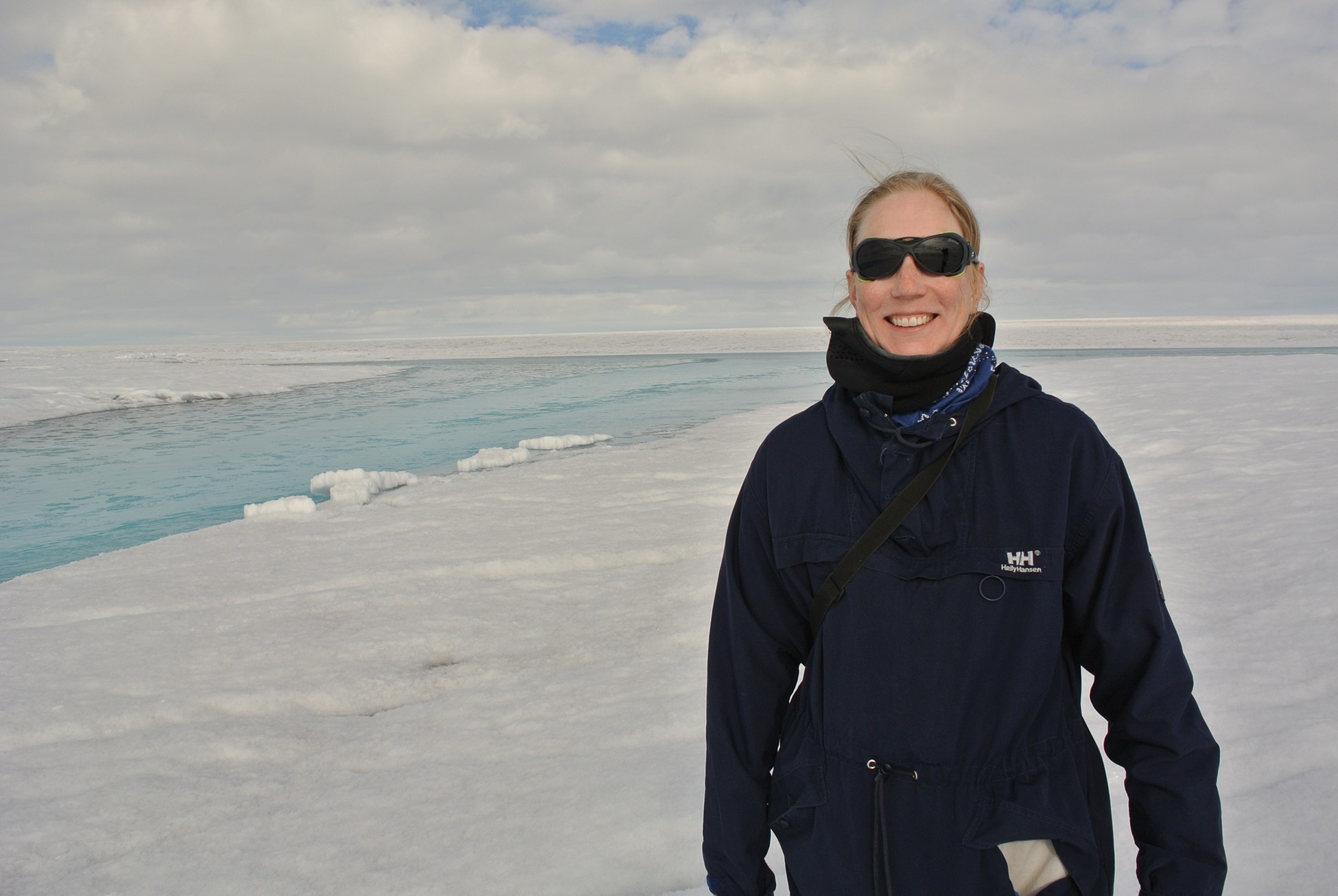
Åsa Rennermalm, co-author of the study, stands next to a pond of melted ice water on top of an ice sheet in Greenland. Photo credits: Åsa Rennermalm.
Thousands of small pools and streams of melted water sitting on top of Greenland’s massive ice sheet are absorbing more heat from the sun than scientists previously realized, according to new research. This discovery means the ice sheet could be melting faster than current models predict, which has important implications for rising sea levels.
Åsa Rennermalm, professor in the Department of Geography, and affiliate of the Rutgers Climate and Energy Institute, is a co-author on this study published in the journal Nature Communications. The research team used both satellite images and high-resolution drone photography to study how meltwater on the ice surface affects melting rates.
The problem comes down to color and heat. Bright white ice and snow reflect most of the sun’s energy back into space, keeping the ice sheet cool. But when water pools form on the surface, they’re much darker and absorb significantly more solar energy—like wearing a black shirt instead of a white one on a hot day. This absorbed energy then melts more ice, creating a dangerous cycle.
Using drone cameras that captured images at a scale of 30 centimeters per pixel, the researchers discovered something surprising: there are thousands of tiny streams and pools—many smaller than an average classroom—that coarser resolution satellite images miss completely. These small features collectively cover more than half of all the ponded water area. Because satellites can’t see them, previous estimates of how much extra melting occurs have been too low by three to four times.
The effect is strongest between 1,000 and 2,000 meters above sea level, in an area called the percolation zone. Here, meltwater pooling causes significant local heating and melting. In warmer years, more water pools form, accelerating the problem.
“Understanding exactly how much these meltwater features speed up ice melting is crucial for predicting future sea-level rise,” said Rennermalm. “Our findings show that current climate models are missing an important piece of the puzzle. By identifying how much additional energy these pools add to the system, we can help improve predictions that communities around the world depend on for planning.”
This research helps explain why the Greenland Ice Sheet—which has been losing mass since the 1990s and contributed about 20% of global sea-level rise between 2006 and 2018—may be melting even faster than scientists thought. The findings suggest that climate models need to account for surface water pooling to accurately forecast how much ice will melt and how quickly seas will rise.
The study’s insights could inform better predictions for coastal planning, infrastructure development, and policy decisions related to climate adaptation. More accurate forecasts help governments and communities prepare for rising seas and make informed decisions about protecting coastal areas where millions of people live.
You can read the full study here: https://doi.org/10.1038/s41467-025-62503-5
This article was written with assistance from Artificial Intelligence, was reviewed and edited by Oliver Stringham, and was reviewed by Åsa Rennermalm, a co-author on the study.