
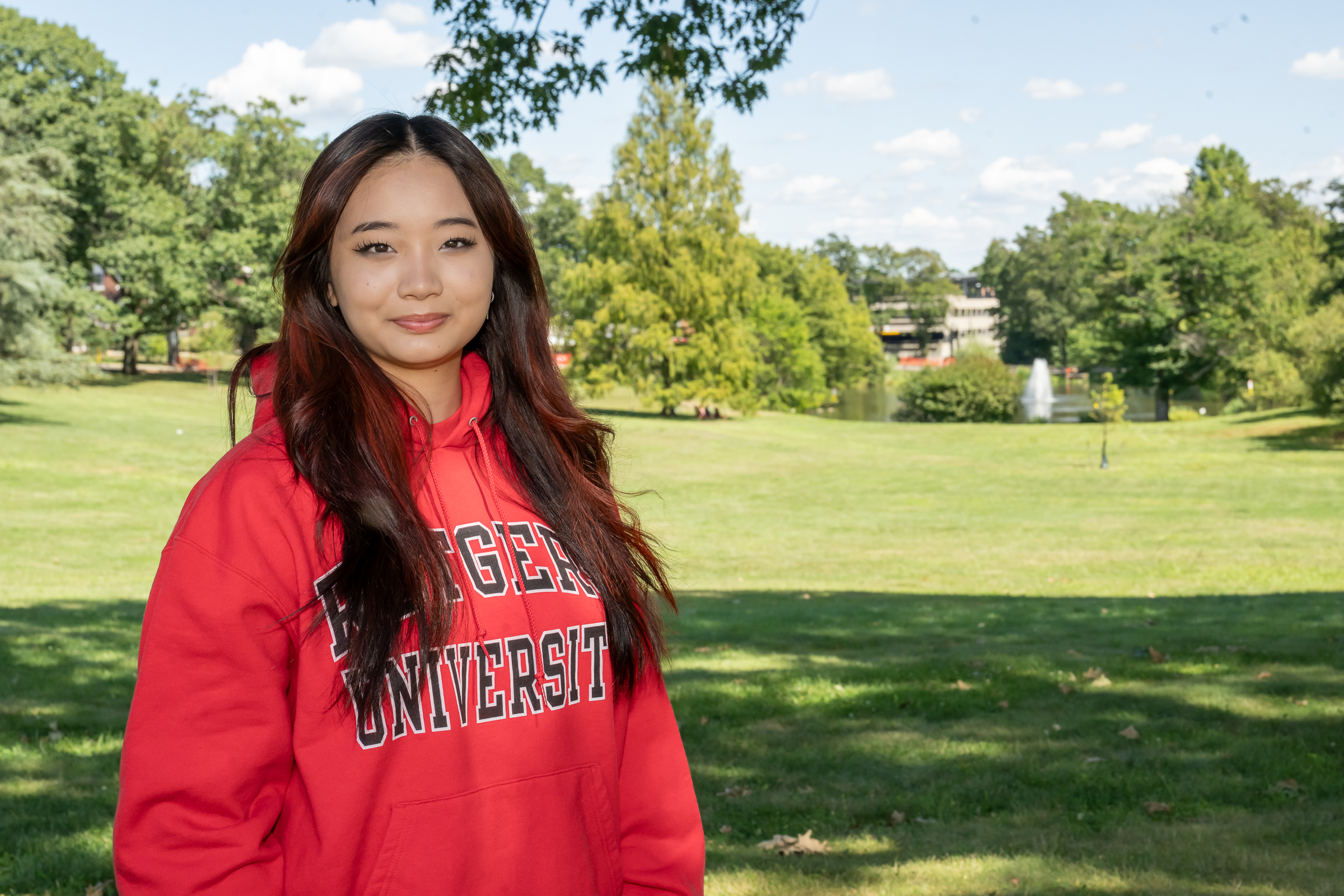
Claire Li SEBS’29. Photo credit: OPOC.
Claire Li was born and raised in Markham, a suburb of Toronto, Canada, and loved the challenge of adjusting and thriving in Hudson College, a high school in the city of Toronto. “Going through the drastic change of staying in the urban city of Toronto to coming home from school to the suburbs was significant to me, as it allowed me to adapt to my surroundings and study wherever I needed to, such as on the train or the subway.”
She begins her first year at college, relatively far from home, in the heart of the Rutgers–New Brunswick campus. A first-year student, she’s looking forward to four years at the School of Environmental and Biological Sciences (SEBS) and has set her mind on a major in either Biochemistry or Chemistry and fulfill her wish to pursue a career in forensics. Why forensics?
“What started off as late-night binging of psychological thrillers like “You” and “Dexter” turned into a fascination with forensics. I’ve grown to be fond of it as it intertwines ethics and science together and helps serve as a voice of justice for the deceased.”
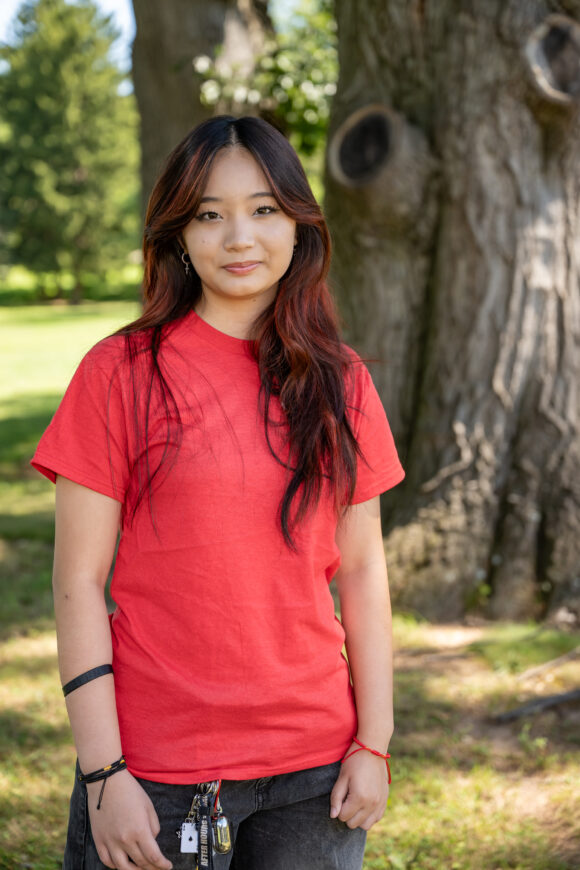
Claire Li SEBS’29. Photo credit: OPOC.
Her interest in chemistry and biology deepened during a summer research program with a professor from Brown University investigating infectious diseases caused by bacteria and viruses and how antibiotic drugs combat bacterial pathogens, and how vaccines fight against viral threats. “This experience allowed me to see how science solves real-world problems while sharpening my research skills at the same time.”
Li has thought deeply about her future and how she’d like to apply her Rutgers education, particularly using science and the strong experiential learning opportunities at SEBS, for the good of society.
“A social issue I would like to explore are wrongful convictions and the reliability of criminal evidence. Using scientific methods and forensics we can improve the accuracy and fairness of the criminal justice system, and it will provide solid proof during convictions rather than just testimonies and eyewitness statements. Exploring this topic allows others to not only expand their scientific techniques but how to think ethically, and with empathy.”
The idea of ethics and justice are very much in her mind, even more so as part of a migrant family that settled in a community that was vastly different from what they had known. Her parents and an older sister migrated from China to Canada “because they wanted a better life, in a country with better opportunities.” Settling in Canada, far from the family’s roots, took some adjustment.
“Initially it was hard to keep our heritage alive and fit in at the same time, but I’m very grateful that my parents have taught me how to enrich my Chinese roots, which allowed me to be able to speak fluently in my home language and let me recognize that I didn’t need to choose between my two identities, but accept myself for being both.”
She has learned to embrace her Chinese heritage. She has thrived in both worlds and expects to do the same at SEBS.
“Looking at my Spotify playlists that ranges from Kendrick Lamar and The Weeknd to Taiwanese bands, such as The Chairs and Deca Joins, the Chinese decorations hanging on my bedroom door and a little red Chinese knot that goes with it hanging on my door handle serves as an entrance to my room, where Frank Ocean and Playboi Carti posters are displayed, showing the balance I found between both worlds.”
Li took the time to share a bit more with SEBS/NJAES Newsroom about why she chose Rutgers, and SEBS in particular, and her activities throughout high school that has molded her interest in science and forensics.
How did you first learn about Rutgers and why did you choose SEBS?
I actually learned about Rutgers while taking inspiration from looking at many different school’s graduation acceptance posts, and one that really stood out to me was Rutgers. I also noticed it wasn’t too far away from Toronto since it was on the East Coast and decided to take my chances and apply. I decided to choose SEBS as it best aligned with my goal of working in forensics, another option I had in mind was the School of Arts and Sciences (SAS). However, I picked SEBS over SAS because it was like a smaller school embedded into Rutgers, which suited my learning style more, as well as the stronger sense of community that came along with it.
How involved were you in extracurricular activities?
My main extra-curricular activity was serving as president of the Science Club at Hudson College. Despite there being a Science club before I transferred there, it was not very active, had no executives and would only operate based on the teacher’s availability, which would be about once every three or four weeks. I approached the teacher and took the initiative to be the president, introduced executive roles, such as a vice president that ran the club with me, workshop helpers that would run presentations or experiments every week, and a social media manager that would make ads for promoting the experiments we conducted, The science experiments were fun and educational at the same time ranging from making lava lamps, ice cream, to dissecting flowers that were observed under microscopes.
What do you consider your most significant accomplishment as a leader in high school?
I think the best initiative I decided to introduce to the Science club would be connecting HOSA, the international organization for students interested in health careers, to Hudson College as it opened a new pathway to healthcare and allowed us to compete in the annual HOSA competition with other high school students in healthcare categories. My close friend and I decided to be partners and competed in the forensic science category. We became the first-ever HOSA competitors at Hudson College, making it to the final round. The year before, I had competed in the same category and placed Top 10 in Forensic Sciences in Canada for the year 2023-2024.
Did you have a particular “passion project” in high school?
I co-founded “InspiringHerStory” with two other close friends as we wanted to highlight women in STEM and female athletes. We would have “Women in STEM Wednesdays” featuring a STEM career and talk about what education requirements you would have to fulfill, the salary, and the definition of the career. We would also have workshops where we taught athletic taping for injuries, the use of artificial intelligence in healthcare, and gene editing. Last but not least, we also had “Throwback Thursday” features where we would feature historical achievements made by women in STEM and female athletes.