

It’s not just all academics. The MSP Scholars also learned about the history and culture of Belize. Courtney Chin explores the Xunantunich Mayan Ruins (200-900 CE), an archaeological site in the western part of the country atop a high ridge overlooking the Mopan River.
In September 2024, the Rutgers Department of Animal Sciences, with Professor Aparna Zama as principal investigator, received a five-year, $250,000 U.S. Department of Agriculture, National Institute of Food and Agriculture (USDA-NIFA) Higher Education Multicultural Scholars Program (MSP) grant for the Rutgers University Veterinary Learning and Preparation program (RU-VETLEAP).
RU-VETLEAP is designed to increase the number of Rutgers Animal Science students applying to and accepted into Doctor of Veterinary Medicine (DVM) programs and those entering careers in USDA mission-critical areas of food, agriculture, and human and animal health. Known as MSP Scholars, five students, all on the preveterinary medicine and research track, were selected to receive the scholarship: Courtney Chin, Cierra Edwards, Kylie Labbe, Santiago Mesa Botero and Kailah Pyron.

Kailah Pyron prepares to go cave tubing at Caves Branch to explore the huge caverns and tunnels that run through the Mayan Mountains.
In addition to academic assistance, mentorship, research training, and professional development, the RU-VETLEAP program also provides a one-time $4,000 special experiential learning (SEL) award to each scholar that can be used to fund such activities as apprenticeships, internships, externships, and study abroad programs relevant to their major. SEL covers living expenses, travel expenses, additional tuition, and/or a cash stipend.
Four out of the five MSP Scholars were able to participate in Summer 2025’s Center for Engaged Learning Abroad (CELA) Belize program, which offers students a firsthand look at local issues affecting conservation, animal health, and ecology, and their impact on global events. In the Large Animal Veterinary Practice in the Tropics course, students gained working knowledge of the husbandry, and health issues confronting farm animals including horses, sheep, pigs, and cattle in Belize. In the Wildlife Health, Ecology & Conservation course, students work with zookeepers at the Belize Zoo to learn about the many factors that affect the management, conservation, habitat and health of wild animals.

Courtney Chin holds Maya, an orange-breasted hawk, at the Belize Raptor Center, a part of the Wildlife Health, Ecology & Conservation course.
The scholars who participated in the CELA Belize program share their experiences.
Courtney Chin (Class of 2028) is part of the Veterinary Science Club (@ruvsc), Companion Animal Club (@rutgerscompanionanimal), and SEBS Governing Council (@sebsgovcouncil), where she served as one of the Animal Science Major Representatives. She hopes to explore different fields of veterinary medicine throughout her undergraduate years and attend veterinary school after graduation. “I thought it was great to get experience with different species of animals to explore a different area of animal science,” she says of her experience in the Wildlife Health, Ecology & Conservation section. “I had a lot of fun with the people in my group, and we did things such as necropsies, body scoring, camera trapping, and enrichment.”
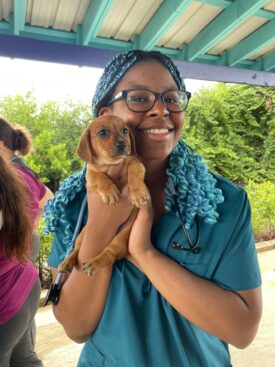
Kylie Labbe holds a puppy that came to a clinic in the resort village of Placencia with its mother and littermates.
Kylie Labbe (Class of 2028) is in the Society of Animal Science (@rusocietyofanimalscience) and Veterinary Science Club. In the summer, she was “shadowing” at a local veterinary clinic and at a wildlife refuge, in addition to studying abroad in Belize. Her goal is to specialize in large animal veterinary medicine. CELA Belize “was a very immersive and rewarding experience, says Kylie. “It helped reaffirm my feelings towards large animal vet medicine and the fact that this is what I want to do. I learned how to vaccinate, give dewormer, proper handling techniques, suturing, and cat neutering.”
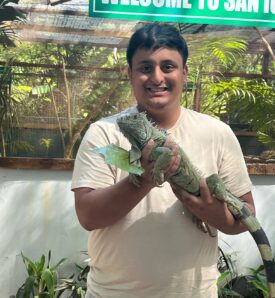
Santiago Mesa Botero holds a green iguana that is part of an educational exhibit called the Green Iguana Conservation Project, where they rehabilitate iguanas and educate the public about the lives of these reptiles and the important role they play in the ecosystem.
Santiago Mesa Botero (Class of 2027) is active in the Minorities in Agriculture Natural Resources and Related Sciences club (MANRRS) (@rumanrrs) and the Colombian American Student Association (CASA) (@casa.rutgers). He has been involved on the Rutgers Farm (@rutgersfarm) as a federal work-study student and with the Rutgers Office for Research-CMR, where he has developed a strong interest in laboratory animal care and medicine. He aims to become a lab animal veterinarian. “During my study abroad trip in Belize, I learned about different cattle breeds that are typically used in tropical areas, such as Brahman and Brangus cattle, which are crosses between Brahman and Angus breeds,” Santiago recounts. “I was able to learn how to conduct a physical exam on horses and body condition score them. I had the opportunity to assist in a community clinic with the Humane Society and practiced anesthetic monitoring, suturing, and assisted in a flank ovariohysterectomy procedure.”
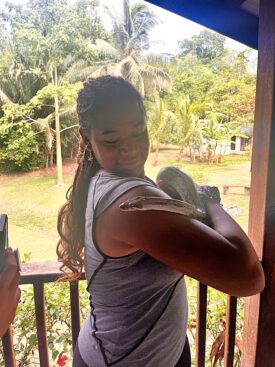
Kailah Pyron handles a boa constrictor that was rescued from a local village and taken to the Belize Raptor Center. The snake serves as an ambassador to educate the community about boas.
Kailah Pyron (Class of 2027) has served as a teaching assistant in Animal Reproduction and contributed to research in an endocrinology lab, gaining valuable experience in hormonal studies. She works as a veterinary assistant at a North Jersey veterinary hospital, and her ultimate goal is to become a veterinarian specializing in wildlife medicine. She participated in the Wildlife Health, Ecology & Conservation course. “Studying abroad really invigorated my passion for being a veterinarian and taught me a lot about what methods are used in the field to collect data on wild animals, as well as what it’s like to sustain those animals in a zoo,” says Kailah. “I also learned about the importance of sustaining ecosystems for wildlife and the importance of educating the public on conservation efforts in order to be successful.”
The SEBS Office of Global Engagement played a pivotal role in making this immersive study abroad experience possible for RU-VETLEAP Scholars. By facilitating access to international programs like CELA Belize, the Office connects students with unique, hands-on learning opportunities that expand their perspectives and deepen their understanding of global challenges in animal and wildlife health. Through faculty partnerships and tailored advising, the Office of Global Engagement empowers SEBS students to broaden their academic journeys beyond the classroom, preparing them to become globally minded professionals and leaders in their fields.
According to Zama, “the MSP scholars had a wonderful time in Belize and have truly broadened their perspectives on different areas of veterinary science that is going to be instrumental for their future successful veterinary school applications. We are truly grateful for the continued support from USDA-NIFA as these students complete their Bachelor of Science degrees. These scholars will fulfill the mission of USDA by becoming the next generation of veterinarians that join the food and agricultural workforce.”