
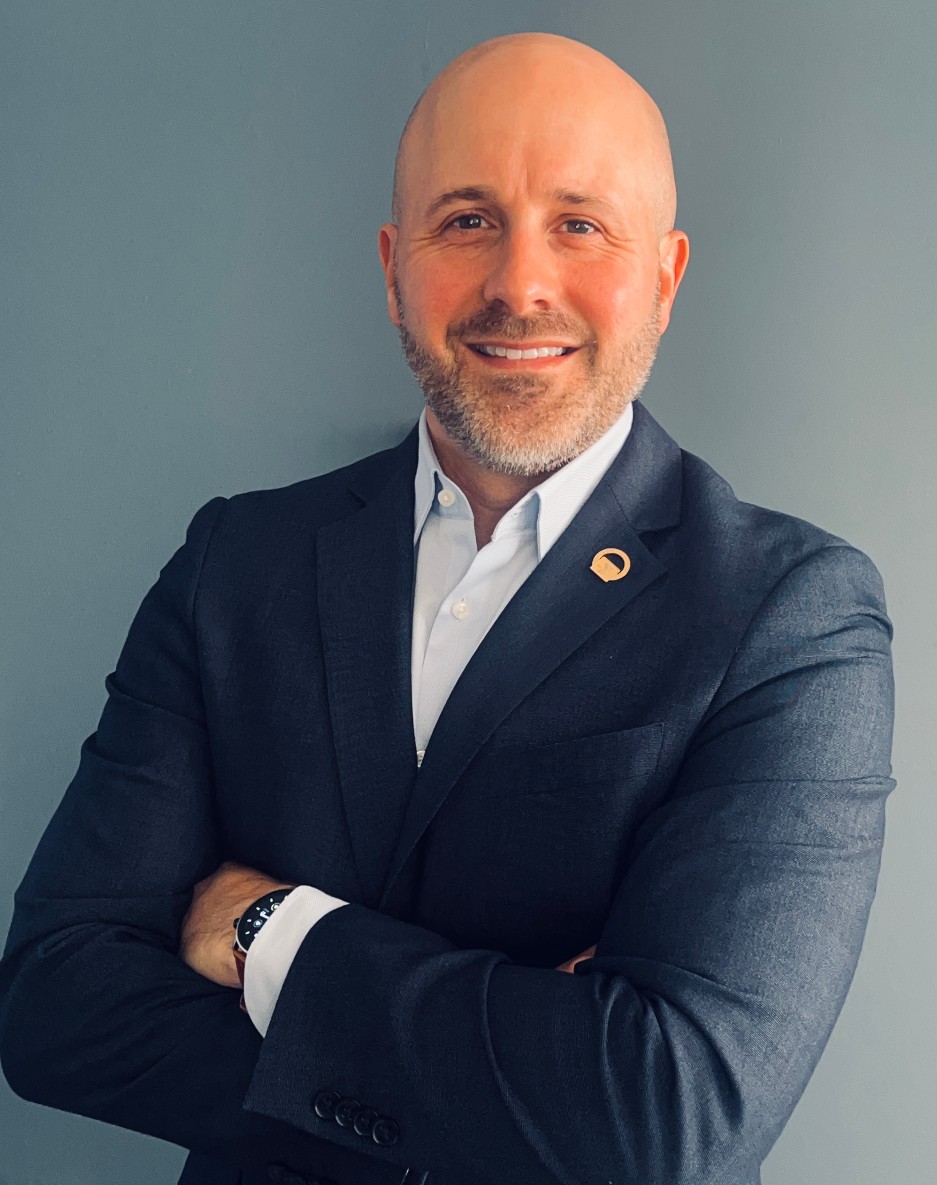
Rutgers alumnus Brian Sheafer CC’02
When Brian Sheafer earned his bachelor’s degree in business economics from Rutgers Cook College in 2002, he set out on a path that combined analytical thinking with a strong commitment to service. That focus has shaped a career dedicated to strengthening communities through the YMCA for more than two decades.
The Metropolitan YMCA of the Oranges recently announced Sheafer’s promotion to Senior Vice President and Chief Operating Officer, effective January 1, 2027. In this role, he helps to guide operations and long-term strategy for the nonprofit, which serves families and communities across Bergen, Essex, and Sussex counties.
Sheafer joined the Metro YMCA of the Oranges in 2016 and has since played a key role in the organization’s growth and impact. He established and chaired Metro Y’s first Safety & Risk Committee. His leadership has helped embed safety as a core organizational priority, expand access to mental health services, and modernize YMCA facilities throughout the region. In addition, he launched Metro Y’s first Mental Health Department in response to growing community need for behavioral health support.
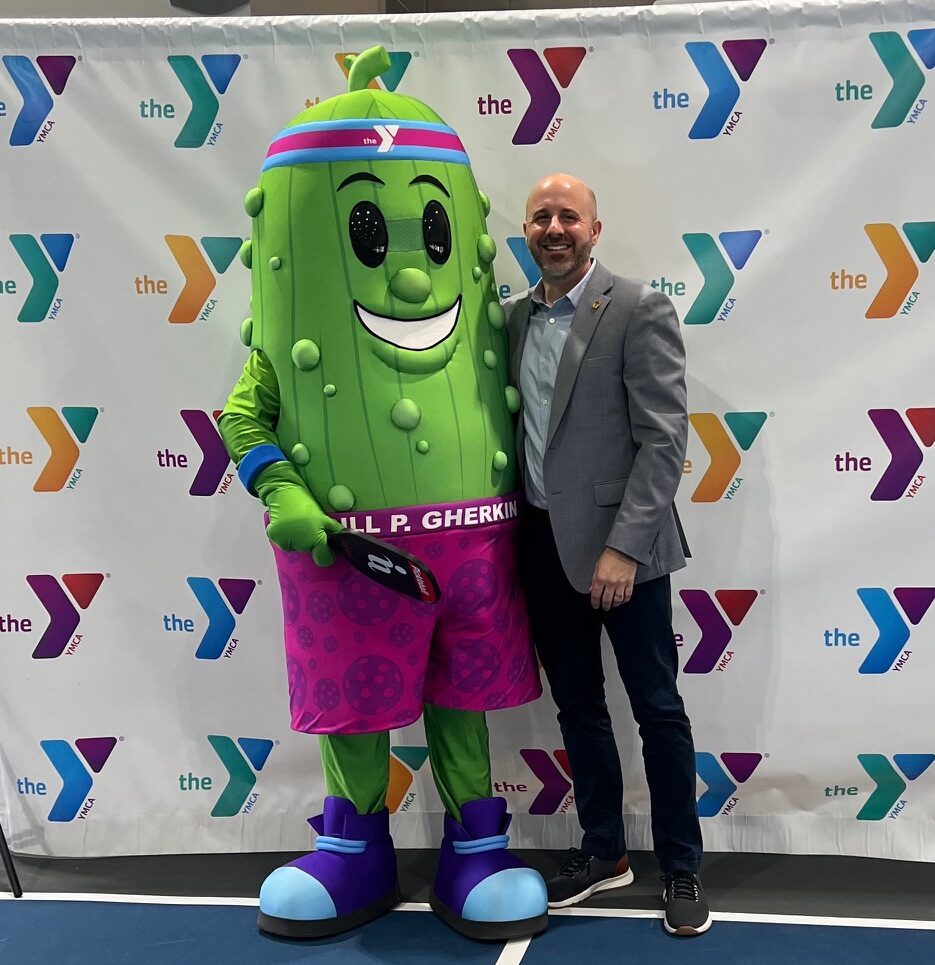
Brian Sheafer with YMCA mascot Dill P. Gherkin at the grand opening of the Sussex County YMCA Pickleball Center, marking the expansion of healthy living amenities for the community.
Under Sheafer’s guidance, the Metro YMCA of the Oranges earned Praesidium Accreditation, the gold standard in child abuse prevention and youth safety practices. Held by only a select group of organizations, the accreditation serves as a benchmark for youth-serving organizations across New Jersey.
His work has also supported more than $53 million in capital projects and helped lay the groundwork for a new, state-of-the-art West Essex YMCA, scheduled to open in late 2026.
Sheafer’s YMCA journey began just one year after graduating from Rutgers. In 2003, he started his career at the Summit Area YMCA and the YMCA of Rahway in New Jersey, building a foundation in youth development, wellness, and community programming. He went on to hold leadership roles across the YMCA network, including serving as Vice President of Youth Development at the YMCA of South Florida and Assistant Vice President at The Learning Experience World Headquarters in Boca Raton, Florida, before returning to New Jersey to join the Metro Y.
Sheafer shared about his undergraduate experience at then Cook College, now the School of Environmental and Biological Sciences.
Why Rutgers?
I had my mind set on attending Rutgers University from a very young age. I still remember being in elementary school and attending an event where the football coach spoke. I can’t point to exactly what he said, but I remember it made me feel excited, curious, and convinced that Rutgers was where I wanted to be. That early spark stayed with me, and years later, walking onto campus felt like the start of something I had been working toward for a long time.
How has your college experience shaped your career?
One of the most meaningful experiences I had was a business and marketing internship with the New Jersey Devils when they were based at the Meadowlands. That experience gave me my first real look at professionalism and accountability in action. I learned what it means to show up prepared, take ownership of your work, and understand how individual effort contributes to a much bigger mission.
Can you recall a favorite Cook memory or a particularly impactful class at Cook?
What I appreciated most about Rutgers was how hands-on the learning was. Whether I was working on the farm, in a science lab, or applying concepts in real-world settings, those experiences made learning feel real and lasting. Environmental Design Analysis, in particular, gave me a deep appreciation for the environment and sustainability. Today, I carry those lessons with me as I help design YMCA community centers and resident camps — spaces meant to serve people while respecting the world around them.
How has Rutgers shaped you as an individual and your career?
Looking back, Rutgers taught me that leadership isn’t about authority, it’s about responsibility. Balancing academics, work, and involvement forced me to develop discipline and time management, but it also taught me the importance of people. I learned that organizations succeed when people feel seen, supported, and valued. Rutgers exposed me to different perspectives and real-world challenges, and it prepared me not just for a career, but for a life centered on service, community, and impact.
For Rutgers alumni, Sheafer’s story is a reminder of how a Rutgers education can serve as a foundation for purpose-driven leadership. As he steps into his new role, he continues to exemplify the values of service, collaboration, and impact that connect Rutgers graduates to communities across New Jersey and beyond.